
Distributed Antenna Systems (DAS): Enterprise Guide to Reliable Indoor Cellular Coverage
Modern enterprise buildings depend on wireless connectivity, but outdoor cellular networks were not designed to perform consistently inside every hospital, office tower, university building, arena, warehouse, or industrial campus.
Dense construction materials, Low-E glass, below-grade areas, elevators, mechanical spaces, and high device density can all weaken cellular signal before it reaches the people and systems that need it.
A Distributed Antenna System, commonly called DAS, is an in-building wireless platform that distributes cellular signal throughout a building or campus using a network of antennas, cabling, and central equipment. For large and complex facilities, DAS helps create more reliable indoor cellular coverage for employees, visitors, tenants, patients, students, operations teams, and connected devices.
This guide explains what DAS is, how DAS systems work, when enterprise teams need them, and how DAS fits into a broader in-building wireless strategy. It is written for leaders evaluating large-scale connectivity investments and looking for a vendor-neutral partner that can assess, design, deploy, optimize, and manage the right solution for each environment.
A Distributed Antenna System helps enterprise buildings and campuses deliver more reliable indoor cellular coverage by distributing carrier signal through a planned network of headend equipment, cabling, and antennas. For large, complex, or high-density facilities, DAS can support more predictable coverage, multi-carrier access, and long-term wireless infrastructure planning.
What Is a Distributed Antenna System?
A Distributed Antenna System is a network of antennas connected to a central signal source that redistributes cellular signal across a building, venue, or campus. Instead of relying only on outdoor macro towers to push signal through walls, glass, concrete, and interior spaces, a DAS brings cellular coverage closer to users inside the facility.
A DAS can support one or more mobile network operators and can be designed around different frequency bands, building conditions, capacity requirements, and performance goals. In enterprise environments, DAS is often used when cellular connectivity needs to be predictable, scalable, and available across large indoor areas.
DAS does not create carrier signal on its own. It distributes signal from a source. That source may come from an off-air donor antenna, small-cell-based signal source, or carrier-connected headend equipment, depending on the building, carrier requirements, budget, performance objectives, and deployment model.
| Aspect | Macro cellular network | In-building DAS system |
|---|---|---|
| Coverage control | Mostly outside-in | Designed for specific interior coverage zones |
| Indoor reliability | Variable, depending on construction and location | Engineered to meet defined coverage and signal quality targets |
| Multi-carrier support | Limited control inside the building | Can be engineered to support multiple operators |
| Best fit | Outdoor mobility and broad public coverage | Large buildings, campuses, venues, and complex indoor environments |
| Ownership strategy | Carrier controlled | Planned around enterprise, property, or venue requirements |
For enterprise teams, DAS is not just a stronger signal project. It is part of the facility’s core connectivity infrastructure.
How a DAS System Works in Large Buildings
A DAS system works by taking cellular signal from a source, conditioning and distributing that signal through a central equipment layer, then delivering it through antennas placed throughout the building.
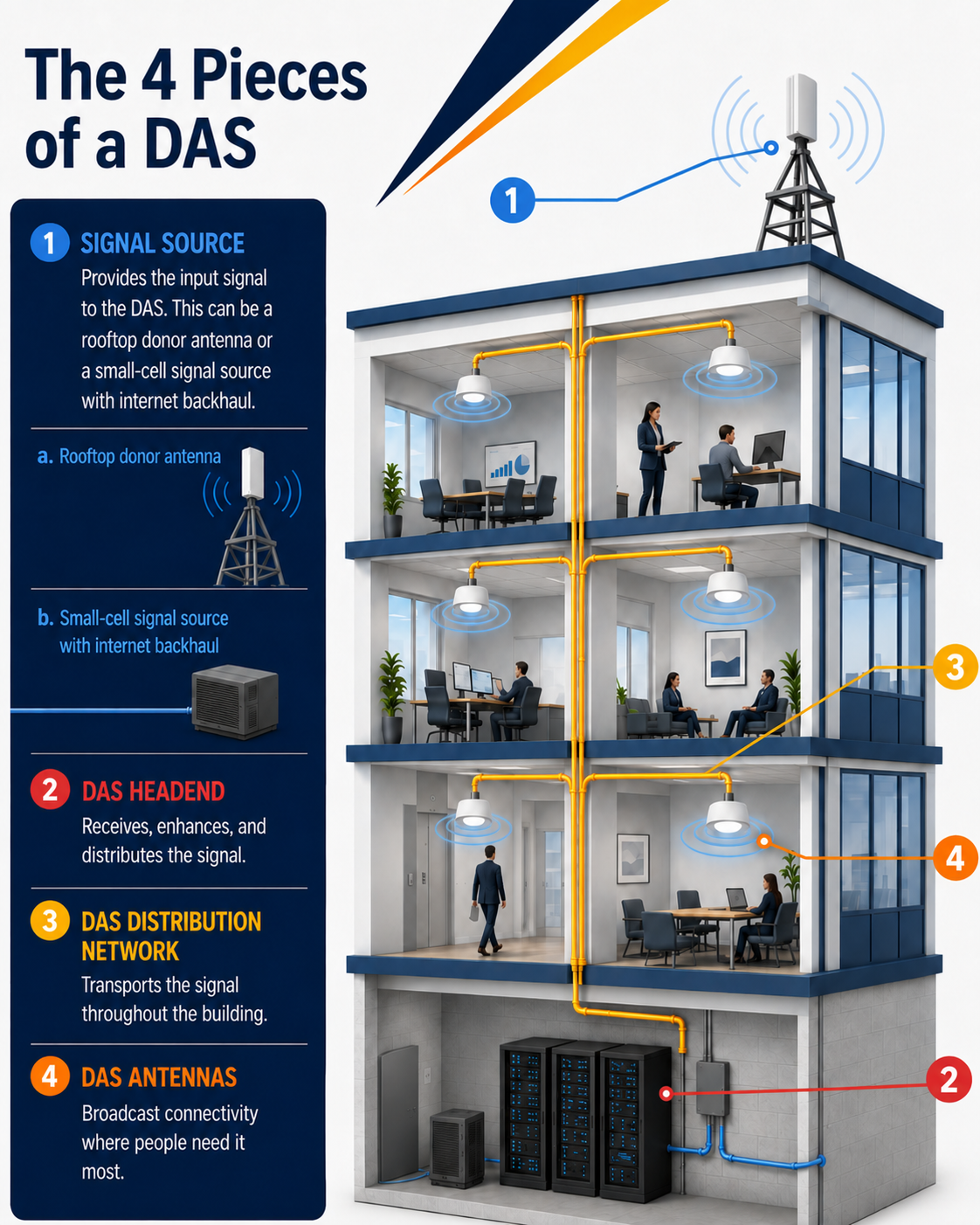
Think of the system in four layers.
1. Signal Source
The signal source determines what the DAS can distribute. A DAS may be fed by off-air signal sources, such as a donor antenna, repeater, or bi-directional amplifier that captures available outdoor macro signal; small-cell-based signal sources, which provide a more controlled source of carrier signal into the DAS; or carrier-connected base station or headend equipment, often used for large or high-capacity deployments where carriers participate directly.
Off-air signal sources can be a lower-cost option in some facilities, but they depend on the quality and availability of outdoor macro signal. Larger buildings, high-density environments, and mission-critical facilities often need a more managed signal source strategy.
2. Headend and Central Equipment
The headend is the central location where the DAS receives, processes, amplifies, and manages the cellular signals before they are distributed. Headend planning is especially important in large buildings because the system may need dedicated space, power, cooling, pathways, carrier coordination, and room for future expansion.
3. Distribution Network
The distribution network moves signal from the headend to antennas throughout the facility. Depending on the design, this may include fiber, coaxial cable, splitters, remote units, and other active or passive components.
Active, passive, and hybrid DAS architectures use different distribution approaches. The right design depends on scale, performance requirements, budget, construction conditions, and future growth needs.
4. Indoor Antennas
Indoor antennas are placed throughout the building to deliver cellular signal where users need it. These antennas may serve lobbies, elevators, stairwells, clinical areas, offices, tenant spaces, concourses, garages, warehouses, manufacturing floors, or other hard-to-reach zones.
From signal source to antenna: carrier signal enters the building through a defined source. The headend processes that signal. The distribution network carries it across the property. Indoor antennas deliver cellular coverage into the spaces where people and devices operate.
When Do Enterprises Need a DAS?
Enterprises usually need DAS when outdoor macro cellular coverage is not enough to support reliable indoor communication across a large or complex facility. The issue is common in modern buildings because the same materials that improve energy efficiency and structural performance can also weaken RF signals.
A DAS may be the right fit when a facility has poor or inconsistent indoor cellular coverage, high user density, multi-carrier requirements, critical operational workflows, or difficult coverage zones that cannot be solved through Wi-Fi alone.
DAS is not just a stronger-signal project. For large and complex facilities, it is part of the building’s core wireless infrastructure.
Hospitals and Health Systems
Healthcare campuses often include dense construction, below-grade spaces, diagnostic areas, operating rooms, elevators, and multi-building layouts. Clinical teams, patients, visitors, security staff, and operations teams all rely on mobile connectivity. DAS helps support more consistent public cellular coverage across the hospital environment.
For a deeper healthcare-specific view, see the healthcare DAS guide. You can also connect this topic to the broader healthcare network connectivity guide. For healthcare-specific private wireless planning, see the healthcare private 5G guide.
Commercial Real Estate and Office Buildings
Class A office buildings, mixed-use properties, high-rises, and commercial real estate portfolios often need reliable cellular coverage to support tenants, visitors, building staff, leasing value, and the workplace experience. Modern Wi-Fi may be strong while cellular coverage still struggles inside tenant suites, garages, elevators, amenity spaces, and common areas.
For CRE-specific planning, see in-building DAS for office buildings. Also see signal source strategy for commercial real estate.
Universities and Corporate Campuses
Large campuses need cellular performance across academic buildings, residence halls, administrative offices, labs, event spaces, common areas, and outdoor transitions. DAS can support consistent coverage across multi-building environments where user density and mobility patterns change throughout the day.
Stadiums, Arenas, and Convention Centers
Venues create extreme density during events. Thousands of users may attempt to call, text, stream, access tickets, use apps, and share content at the same time. DAS can be designed for both coverage and capacity, helping support the high-density demands of event environments.
Industrial, Manufacturing, Warehouse, and Logistics Facilities
Industrial campuses and logistics facilities often include large footprints, metal structures, high ceilings, thick walls, equipment interference, and operational mobility. Cellular coverage may be needed for staff communication, safety workflows, scanners, connected equipment, and future private wireless strategies.
DAS vs. Wi-Fi, Small Cells, and Other In-Building Options
DAS, small cells, Wi-Fi, Wi-Fi calling, and private wireless are not interchangeable technologies. Each serves a different role in an enterprise connectivity strategy.
DAS
DAS is best for licensed public cellular coverage, especially when a building needs consistent multi-carrier voice and data service. It supports devices that depend on carrier networks and is often the preferred path for large buildings, campuses, venues, and complex facilities where indoor cellular reliability matters.
Small Cells and Distributed Radio
Modern indoor small-cell and distributed radio platforms can serve as an alternative to a traditional DAS architecture. These systems use carrier-connected indoor radio infrastructure and a more digital, IT-aligned architecture rather than a conventional DAS RF distribution layer.
In the right environment, they can provide a platform-level approach to indoor cellular coverage rather than serving as a targeted or localized coverage fix. In some architectures, small-cell-based signal sources can also feed a DAS and provide a more managed source of carrier signal.
This distinction matters. Small cells are not simply an add-on to DAS. They may be the primary in-building cellular architecture or part of the signal source strategy behind a DAS deployment.
Wi-Fi
Wi-Fi is best for enterprise-controlled data networks, guest access, internal applications, and devices managed by the organization. It is essential in most enterprise environments, but strong Wi-Fi does not automatically solve cellular coverage problems.
Users still rely on carrier networks for voice, text, authentication, public mobile access, and many personal and business applications.
Wi-Fi Calling
Wi-Fi calling can be an emerging option in some enterprise environments, especially where organizations already have strong Wi-Fi performance and want to support voice coverage in select use cases. It should still be evaluated carefully because user experience, carrier behavior, device settings, authentication, and operational requirements can vary.
Private Wireless
Private wireless networks, including private LTE and private 5G, are designed for enterprise-controlled connectivity using dedicated spectrum, policy, and quality-of-service controls. They are often considered for operational use cases such as connected devices, automation, security, mobility, telemetry, or high-reliability enterprise applications.
Private wireless does not replace public cellular DAS in every case. It serves a different purpose: enterprise-controlled connectivity for specific users, devices, and applications.
For a broader look at enterprise private wireless, see CTS private wireless networks.
| Need | Best-fit technology |
|---|---|
| Multi-carrier public cellular coverage across a large building | DAS or small cell |
| Enterprise-managed LAN and guest data access | Wi-Fi |
| Modern indoor cellular architecture with flexible deployment requirements | Small cells or distributed radio |
| Managed signal source feeding a DAS | Small-cell-based signal source |
| Enterprise-controlled spectrum, QoS, and operational mobility | Private wireless |
| Emerging voice support option where appropriate | Wi-Fi calling |
Most large enterprises need a strategy that coordinates multiple wireless layers rather than treating one network as the answer to every connectivity requirement.
DAS Architectures and Design Considerations
DAS design should start with the building’s requirements, not a predetermined product stack. The right architecture depends on coverage goals, capacity needs, carrier participation, construction conditions, budget, schedule, and long-term operating strategy.
Active, Passive, and Hybrid DAS
An active DAS typically uses fiber and remote electronics to distribute signal across larger or more complex environments. It is often the better fit when scale, capacity, and future growth matter more than initial simplicity.
A passive DAS uses coaxial cabling, splitters, and antennas to distribute signal. It can be appropriate for simpler coverage needs, smaller footprints, or tighter capital budgets.
A hybrid DAS combines elements of both. It may use fiber for longer runs or larger zones while using passive components closer to the antennas.
For a deeper comparison, see the active vs. passive DAS guide.
Signal Source Strategy
Signal source strategy is one of the most important decisions in a DAS project. The DAS can only distribute the signal it receives. If the source is weak, unstable, limited to one carrier, or difficult to coordinate, the system’s performance and schedule can be affected.
Off-air sources may work when outdoor macro signal is strong and the building’s needs are relatively straightforward. For larger or more complex buildings, a managed signal source can provide a more predictable foundation. CTS Forté Neutral Source is essentially a managed small-cell-based signal source for DAS, designed to support more predictable multi-carrier planning where the building owner needs a clearer path than traditional carrier-funded deployment models.
Multi-Carrier and Multi-Band Design
Enterprise environments often need support for multiple mobile network operators because users do not all rely on the same carrier. A multi-carrier DAS can help provide a more consistent experience for employees, visitors, tenants, patients, students, contractors, and event attendees.
Designers also need to account for frequency bands, carrier requirements, equipment compatibility, RF performance, interference, and future capacity needs.
Capacity and Growth Planning
Coverage is only one part of DAS design. Large buildings also need capacity planning. A system that works well when a building opens may struggle later if device density increases, tenant needs change, medical or operational devices expand, or the facility adds new applications.
A well-planned DAS should consider future carrier requirements, private wireless readiness, IoT growth, network monitoring, and lifecycle support.
Public Safety DAS and ERRCS Coordination
Public safety DAS and Emergency Responder Radio Communication Systems serve a different purpose from commercial cellular DAS. Public safety systems are designed to support emergency responder communications and may be driven by local code requirements and the authority having jurisdiction.
Commercial DAS and public safety DAS should be planned together where possible, but they should not be treated as the same system. Pathways, risers, power, rooms, and testing requirements often need early coordination.
What to Look for in a DAS Partner
Choosing a DAS provider is not only about selecting equipment. It is about finding a partner that can translate building requirements, carrier requirements, RF design, construction realities, and long-term support needs into a working system.
Look for a DAS partner with:
- Vendor-neutral design experience. The provider should not force one manufacturer, carrier, or architecture into every environment.
- RF engineering expertise. Large buildings and campuses require detailed modeling, testing, design, optimization, and troubleshooting.
- Carrier coordination experience. Multi-carrier DAS projects often require communication with mobile network operators and alignment with carrier technical requirements.
- Enterprise and vertical experience. Hospitals, office buildings, campuses, venues, and industrial facilities each create different design constraints.
- End-to-end services. Assessment, design, installation, commissioning, optimization, monitoring, maintenance, and lifecycle management should be part of the plan.
- National reach. Multi-site enterprises and real estate portfolios need consistent delivery across regions.
The right DAS provider should be able to explain the tradeoffs clearly. That includes when DAS is the right approach, when small cells may be better, when an off-air source is appropriate, when a managed signal source should be considered, and how Wi-Fi or private wireless fit into the broader strategy.
How CTS Delivers Enterprise DAS
CTS designs, builds, runs, and supports custom in-building and campus connectivity solutions for complex enterprise environments. The approach is vendor neutral, which means the design starts with the customer’s requirements rather than a single product stack.
Assessment
CTS begins by evaluating the building, campus, or portfolio. This may include coverage testing, RF surveys, construction review, capacity evaluation, carrier needs, user requirements, public safety considerations, and future growth planning.
Design and Engineering
CTS develops a DAS design based on the facility’s coverage zones, signal source strategy, carrier requirements, architecture, pathways, equipment locations, and performance objectives. The design may account for active, passive, or hybrid DAS approaches depending on the environment.
Implementation
CTS manages deployment across the physical and technical layers of the project, including cabling, equipment installation, antenna placement, headend setup, coordination with project teams, and alignment with construction schedules where applicable.
Optimization and Commissioning
After installation, the system must be tested and optimized. CTS validates performance, addresses coverage or interference issues, and helps ensure the DAS is operating as designed.
Lifecycle Management
Enterprise DAS is not a one-time installation. Buildings change, carrier networks evolve, tenants move, device density increases, and performance requirements grow. CTS supports ongoing management, monitoring, maintenance, and optimization so the system can continue serving the facility over time.
Because CTS works across healthcare, commercial real estate, campuses, venues, and industrial environments, the team can help enterprises design DAS as part of a broader connectivity roadmap that may also include Wi-Fi, public safety DAS, private wireless, and managed signal source strategies.
Plan Your Enterprise DAS Strategy With CTS
Reliable indoor cellular coverage is now part of enterprise infrastructure planning. Whether you are designing a new facility, upgrading a large building, solving recurring coverage complaints, or evaluating a multi-site wireless roadmap, the right DAS strategy starts with the building’s needs, user requirements, carrier goals, and long-term operating model.
CTS helps enterprise teams design and deploy vendor-neutral DAS solutions across hospitals, commercial real estate portfolios, campuses, venues, and industrial facilities.
Planning a new DAS system or evaluating your current indoor cellular coverage? Connect with CTS to design a vendor-neutral DAS solution for your enterprise facilities.
The right DAS strategy starts with the building, not the equipment.
For enterprise facilities, the right question is not whether DAS is always better than another technology. The better question is which indoor wireless architecture best fits the building’s coverage goals, carrier requirements, user density, available infrastructure, budget, and long-term operating model.
CTS takes a vendor-neutral approach to DAS planning, helping organizations evaluate signal source options, compare DAS and small-cell architectures, coordinate carrier requirements, and design in-building wireless systems around real facility needs.
Talk to a CTS connectivity expertDistributed Antenna System FAQs
What is a Distributed Antenna System?
A Distributed Antenna System, or DAS, is an in-building wireless network that distributes cellular signal from a central source to antennas placed throughout a building, venue, or campus.
How does a DAS improve indoor cellular coverage?
DAS brings cellular signal closer to users inside the building instead of relying only on outdoor towers to penetrate walls, glass, concrete, and interior spaces.
What are the main parts of a DAS?
A DAS typically includes a signal source, headend or central equipment, a distribution network, and indoor antennas that broadcast cellular signal into coverage areas.
Is DAS better than Wi-Fi?
DAS and Wi-Fi serve different needs. DAS supports licensed public cellular coverage, while Wi-Fi supports enterprise-controlled data access, guest networks, and internal applications.
Is DAS better than small cells?
DAS is often a strong fit for large, complex, multi-carrier environments. Small cells or distributed radio may be a better fit when the building, carrier strategy, available space, or deployment model favors a more compact indoor cellular architecture.
How long does a DAS deployment take?
Timelines vary based on building size, design complexity, carrier coordination, signal source strategy, construction conditions, permitting, and commissioning requirements.
What should I look for in a DAS provider?
Look for RF engineering expertise, carrier coordination experience, vendor-neutral design capabilities, national deployment resources, and lifecycle support.