
In-Building DAS for Office Buildings Is Becoming Essential Infrastructure
Office buildings were not originally designed around mobile connectivity. Today, tenants walk into the office expecting their phones, collaboration tools, mobile apps, authentication systems, and video platforms to work instantly across every floor of the building.
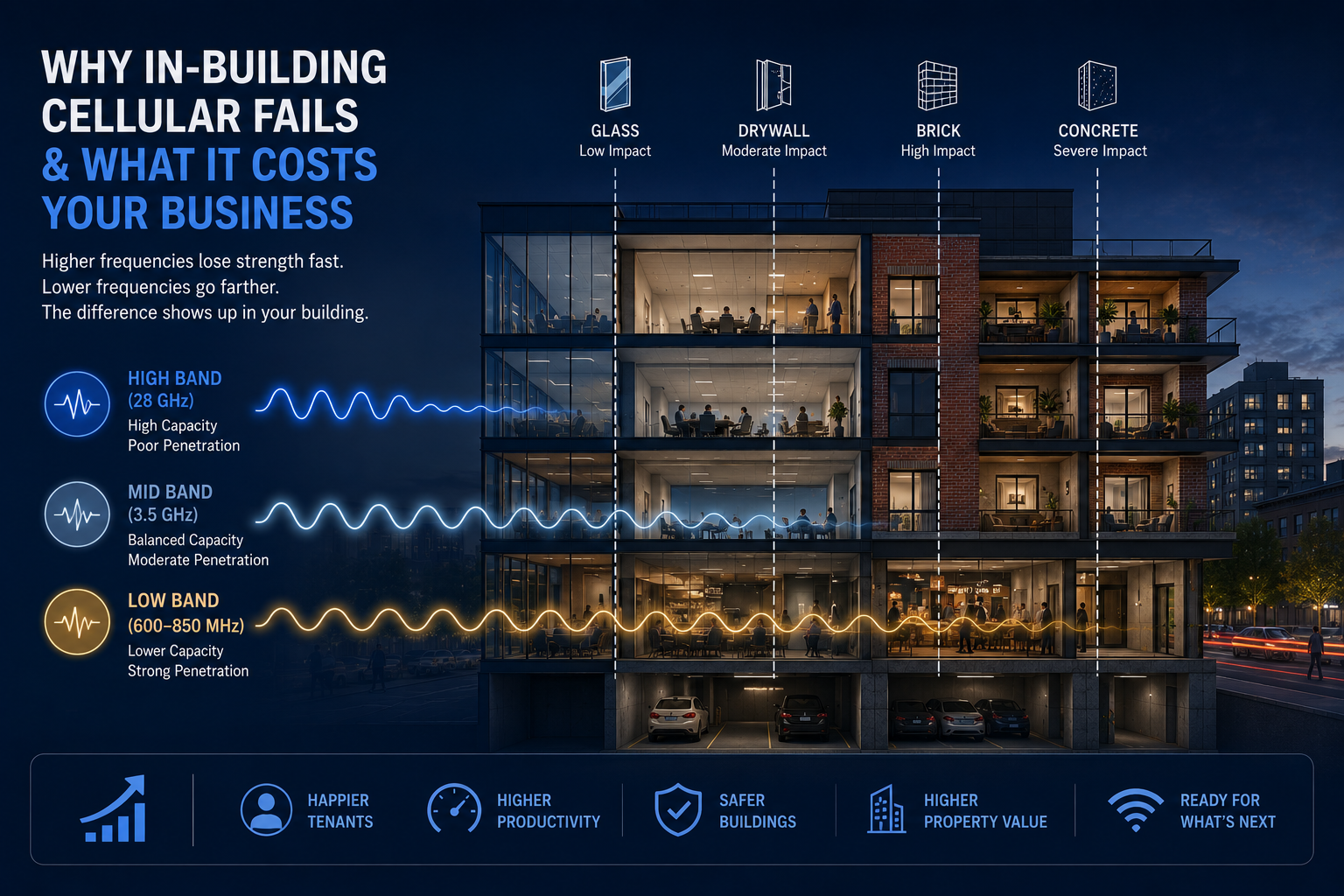
When those tools do not work, frustration builds quickly. The issue is no longer isolated to poor signal near elevators, stairwells, or parking garages. Modern office buildings are creating widespread indoor cellular performance problems because the same materials used to improve energy efficiency and building performance can also block or weaken carrier signals from reaching occupants inside the property.
That shift is forcing commercial real estate owners, property managers, and enterprise facilities teams to rethink wireless connectivity as core building infrastructure.
In-building DAS is becoming essential infrastructure for many office buildings because modern materials, dense layouts, high device usage, and inconsistent outdoor carrier signal can weaken indoor cellular performance. The strongest DAS strategies evaluate both the distribution design and the signal source feeding the system, especially for multi-tenant, multi-carrier, and high-density commercial properties.
Why Office Buildings Struggle With Cellular Coverage
Most office buildings interfere with wireless signals by design. Coverage issues are often created by a combination of construction materials, building layout, and user density.
Low-E glass, reinforced concrete, steel, brick, dense interior walls, elevator shafts, mechanical rooms, stairwells, and underground parking structures can all weaken or block carrier signals before they reach the people inside the property.
Common causes of poor office building cellular coverage include:
- Low-E glass that reflects or weakens RF signals
- Reinforced concrete and steel construction
- Dense floorplans and enclosed interior conference rooms
- Elevators, stairwells, mechanical areas, and underground parking structures
- High device density across tenants, visitors, contractors, and property teams
- Hybrid work patterns that increase reliance on mobile authentication, collaboration tools, and cloud-based applications
The result is inconsistent cellular performance throughout the building. Tenants may experience dropped calls during meetings, delayed text messages and authentication codes, poor mobile data performance, or unreliable video conferencing on cellular devices.
In practice, users rarely blame the carrier first. They blame the building. That makes indoor wireless performance a property experience issue, not just a technical issue.
What Is an In-Building DAS?
An in-building Distributed Antenna System, or DAS, distributes cellular signal throughout a property using a network of strategically placed antennas connected to a centralized signal source.
Instead of relying on outdoor towers to penetrate the building from the outside, DAS brings carrier signal into the property and distributes it across the areas where people actually need service.
For large office buildings, DAS treats wireless connectivity as infrastructure rather than an afterthought. A well-designed DAS can support more consistent cellular coverage, better performance across multiple floors, reliable connectivity in common areas and interior spaces, and multi-carrier access for tenants and visitors.
That matters because commercial properties are shared environments. A single office tower may support several tenants, multiple carriers, high visitor traffic, conference spaces, amenity floors, security systems, and lower-level parking areas. DAS gives the property a more engineered way to support those needs.
Why the DAS Signal Source Matters
A DAS is only as effective as the signal source feeding it. This is one of the most important points for office building owners to understand when evaluating indoor wireless options.
Some in-building systems use an off-air repeater or signal booster as the signal source. In that model, an external donor antenna captures available outdoor carrier signal, amplifies it, and feeds that signal into the in-building wireless system.
This approach can work in certain environments, especially when the outdoor signal is strong, clean, and available in a location where the building can capture it reliably.
Larger commercial properties are often more complex. Office towers, multi-tenant buildings, mixed-use properties, and corporate campuses may need greater coverage consistency, more capacity, carrier coordination, and a signal-source strategy that can scale over time. In those environments, the signal source should be evaluated as carefully as the DAS distribution design itself.
A DAS is only as effective as the signal source feeding it.
Off-Air Signal Sources vs. Carrier-Connected Signal Sources
The key question is not simply whether a building needs DAS or a signal booster. The better question is: what type of signal source should feed the DAS?
An off-air signal source depends on the available outdoor carrier signal. If that signal is strong and uncongested, an off-air approach may provide a practical path to improving indoor coverage. But if the outdoor signal is weak, noisy, blocked, or congested, the DAS may inherit those limitations.
A carrier-connected signal source is different. Instead of depending only on the surrounding macro network, it is coordinated with carrier requirements and designed to provide a more controlled source of cellular signal into the building.
For commercial property teams, this distinction can affect coverage reliability, capacity, scalability, and long-term performance.
Managed Signal Sources Can Improve DAS Reliability
For buildings where off-air signal conditions are inconsistent or where property teams need a more predictable multi-carrier strategy, a managed signal source may be a better fit.
A managed signal source is designed to provide a controlled, carrier-connected foundation for the DAS rather than relying solely on whatever signal can be captured from outside the building.
CTS Forté Neutral Source is an example of this approach. It is positioned as a managed signal source for enterprise DAS deployments, helping commercial properties feed the DAS with a more reliable carrier-connected signal source.
For office buildings, this can reduce uncertainty around outdoor signal conditions and create a more predictable foundation for indoor wireless performance.
This is especially relevant for office towers, multi-tenant properties, mixed-use commercial developments, corporate campuses, and buildings where cellular reliability is tied to tenant experience, leasing perception, and long-term property competitiveness.
Multi-Carrier DAS Matters in Commercial Real Estate
One of the biggest mistakes in office building wireless planning is designing around a single carrier.
Tenants use different networks. Visitors use different networks. Employees move between devices throughout the day. A property may solve the problem for one group of users while leaving others with the same poor experience.
An effective in-building DAS strategy for commercial real estate should account for the major carriers tenants and guests are likely to use, including AT&T, Verizon, T-Mobile, and future network upgrades.
It should also consider how carrier requirements, spectrum changes, and 5G evolution may affect the building over time.
Without multi-carrier planning, a property may invest in indoor wireless infrastructure and still leave portions of the tenant population underserved.
Connectivity Has Become Part of the Leasing Conversation
Reliable indoor wireless coverage is no longer viewed as a technical feature. It has become part of how tenants evaluate buildings.
Commercial real estate teams are seeing connectivity influence tenant satisfaction, lease renewals, workplace productivity, hybrid work adoption, visitor experience, and overall building perception.
Buildings with poor mobile performance increasingly feel outdated, even when other amenities are modernized.
For tenants, poor indoor cellular service can create daily friction. For building owners, that friction can become a leasing and retention issue.
Strong indoor wireless performance helps the building feel modern, functional, and ready for the way people work today.
Designing the Right DAS Strategy for an Office Building
No two office buildings require the exact same architecture. The right in-building DAS strategy depends on the size and layout of the property, construction materials, user density, tenant mix, carrier requirements, parking garages, lower-level spaces, and long-term ownership goals.
The strongest deployments begin with understanding how people actually move through and use the building every day. Coverage planning should account for tenant floors, amenity areas, conference centers, elevators, stairwells, lobbies, loading areas, mechanical spaces, and parking structures.
That planning should include both the DAS distribution design and the signal-source strategy. When those two elements are aligned, the building is better positioned to deliver reliable indoor wireless coverage at the scale modern tenants expect.
Building a Better Indoor Wireless Experience
In-building DAS for office buildings is no longer niche infrastructure. It has become part of the tenant experience, operational environment, and long-term competitiveness of the property.
CTS designs and deploys enterprise-grade in-building DAS solutions for commercial real estate environments, including office towers, multi-tenant properties, mixed-use developments, and corporate campuses.
For organizations evaluating indoor wireless strategy, the goal is not simply stronger signal. The goal is creating a building where connectivity works consistently, reliably, and at the scale modern tenants expect.
The signal source should be planned as carefully as the DAS itself.
For office buildings, DAS performance depends on more than antenna placement. CTS helps property teams evaluate outdoor signal conditions, carrier requirements, building layout, and long-term coverage goals so the DAS is supported by the right signal-source strategy.
The right approach may include an off-air source in some environments or a managed, carrier-connected signal source when the property needs a more predictable foundation for multi-carrier indoor wireless performance.
Talk to a CTS connectivity expertIn-Building DAS for Office Buildings FAQs
Does every office building need an in-building DAS?
Not every office building needs DAS, but many large office buildings, high-rises, multi-tenant properties, corporate campuses, and mixed-use commercial buildings benefit from an engineered in-building wireless system when outdoor carrier signals cannot provide reliable indoor coverage.
Why do office buildings have poor cell signal?
Office buildings often have poor indoor cellular signal because Low-E glass, reinforced concrete, steel, dense interior layouts, elevators, stairwells, underground parking areas, and high device density can weaken or block carrier signals.
What is an in-building DAS for office buildings?
An in-building DAS is a Distributed Antenna System that distributes cellular signal throughout an office property using antennas, cabling, and a centralized signal source. It is designed to improve indoor cellular coverage and performance across the building.
Is a signal booster the same as a DAS?
A signal booster is not the same as a complete DAS. In many commercial systems, a booster or repeater may serve as an off-air signal source that captures outdoor signal and feeds it into an indoor system. DAS refers to the broader distributed antenna network that delivers cellular coverage throughout the building.
When is an off-air signal source appropriate?
An off-air signal source may be appropriate when the outdoor carrier signal is strong, clean, and available in a location where the building can capture it reliably. If outdoor signal conditions are weak, congested, or inconsistent, a managed or carrier-connected signal source may be a better fit.
What is a managed signal source for DAS?
A managed signal source is a more controlled signal-source strategy that is coordinated with carrier requirements rather than relying only on off-air signal conditions. It can help provide a more reliable foundation for enterprise DAS performance.
Why is the DAS signal source important?
The signal source determines the quality and reliability of the signal that feeds the DAS. If the source signal is weak, noisy, or capacity-constrained, the in-building DAS may not deliver the performance the property expects.
What is multi-carrier DAS?
Multi-carrier DAS is an in-building wireless system designed to support more than one mobile network operator, such as AT&T, Verizon, and T-Mobile. This helps provide a more consistent experience for tenants, employees, and visitors who use different carriers.