
PUBLIC SAFETY DAS
Public Safety DAS, ERRCS and ERCES Systems for First Responder Radio Coverage
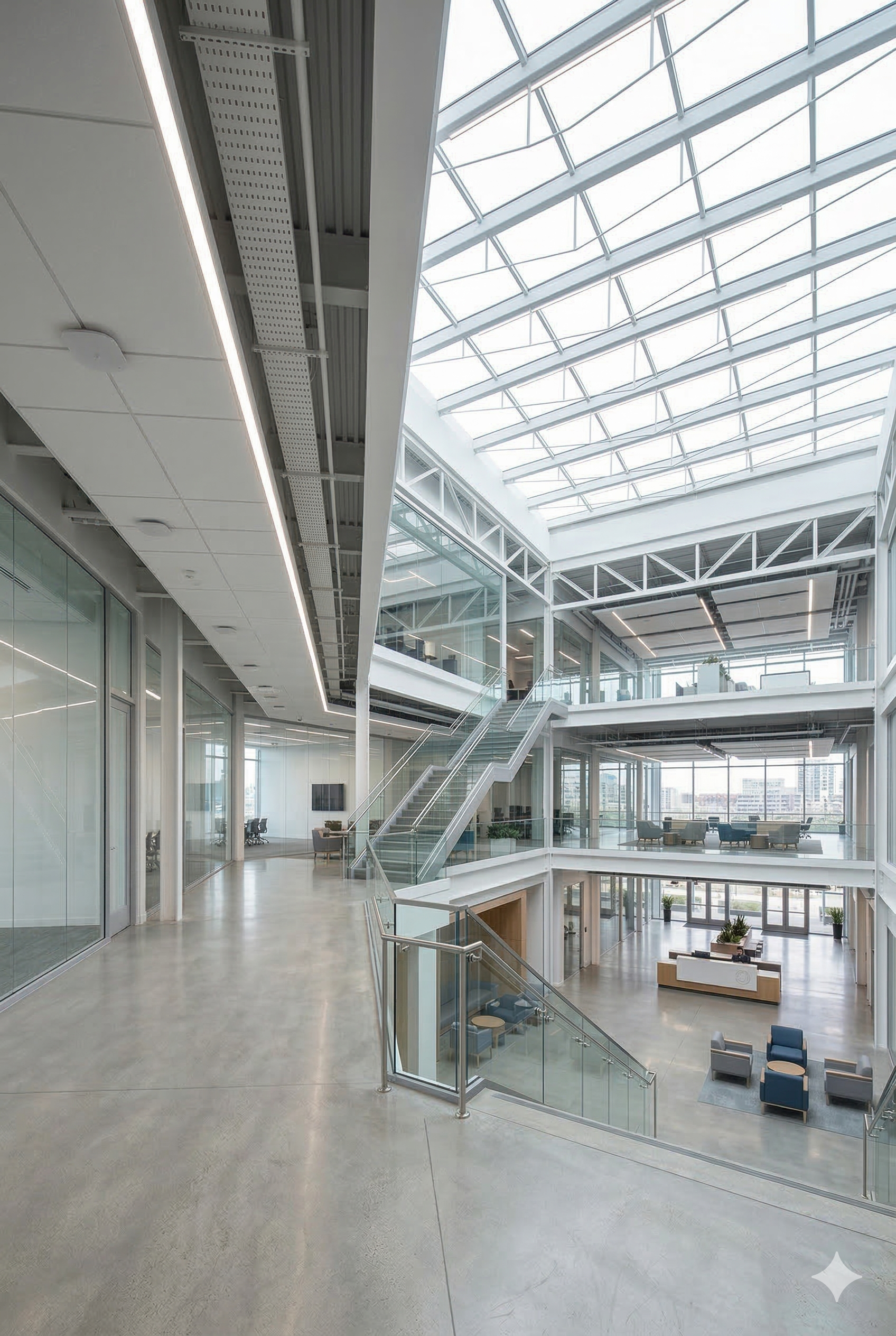
CTS designs, installs, tests, and maintains Public Safety DAS, ERRCS, and ERCES systems that support reliable police, fire, and EMS radio communications inside buildings. Each system is engineered around adopted codes, local AHJ requirements, public safety radio frequencies, and building conditions.
IFC Section 510 • NFPA 1225 • AHJ Coordination
Nationwide Design, Deployment & Lifecycle Support

IFC 510 Alignment
Public safety radio coverage systems designed around adopted International Fire Code requirements and local amendments.

NFPA 1225 Standards Knowledge
ERRCS and ERCES systems engineered with awareness of current emergency responder communication standards.

Nationwide Deployment
Supporting commercial buildings and critical infrastructure across the United States.

AHJ Coordination
Coordination with local Authorities Having Jurisdiction to support plan review, testing, and acceptance.

Testing, Maintenance and Lifecycle Support
RF testing, system design, installation, acceptance testing, maintenance, and ongoing support.
QUICK ANSWER
WHAT IS A PUBLIC SAFETY DAS, ERRCS, or ERCES?
A Public Safety DAS, ERRCS or ERCES is an in-building emergency responder radio coverage system that helps firefighters, police officers, EMS teams, and other authorized first responders communicate inside a building. It is separate from commercial cellular DAS and is designed around public safety radio frequencies, adopted code requirements, AHJ criteria, testing, backup power, monitoring, and acceptance.
Why Buildings Fail Public Safety Radio Coverage Testing
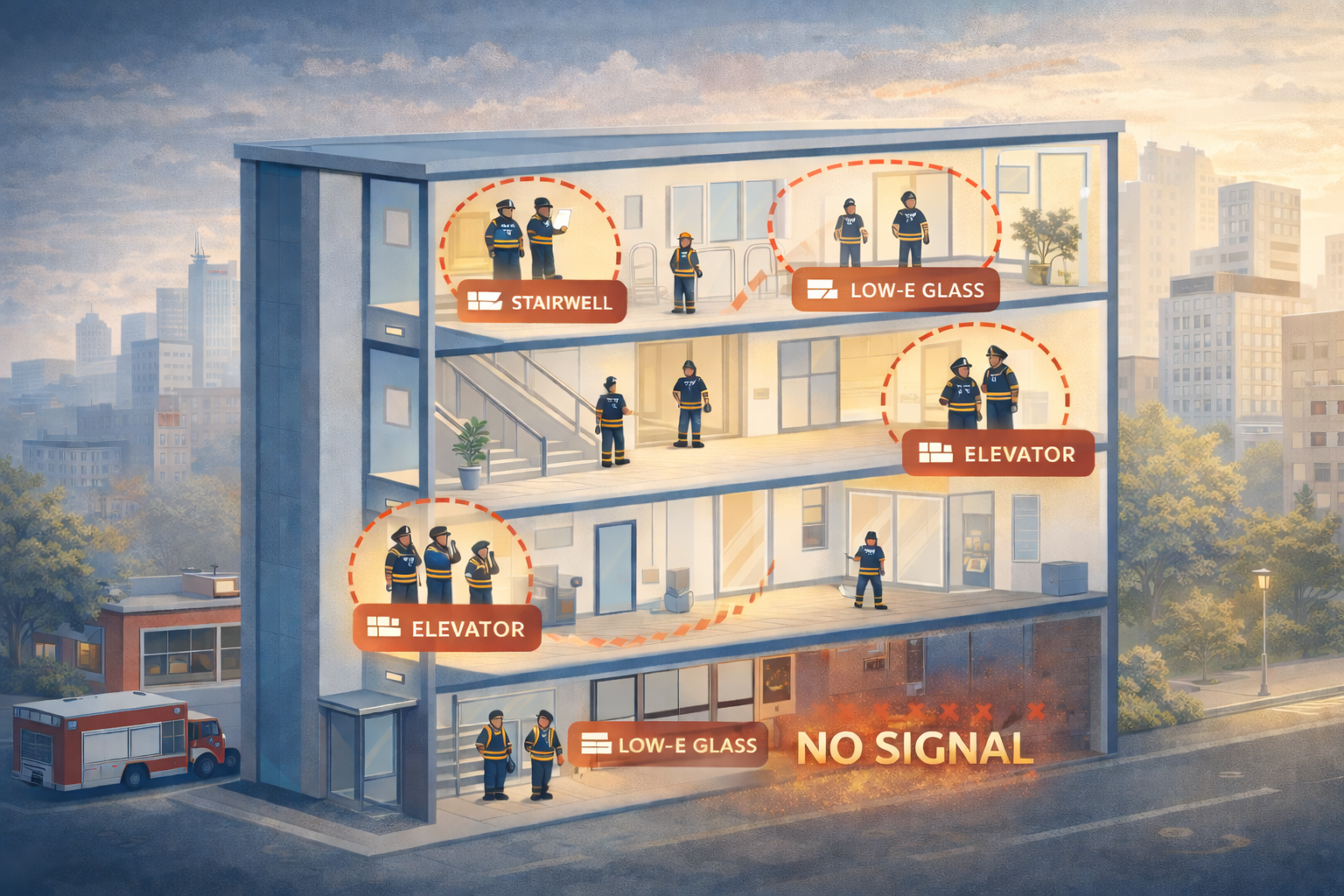
Buildings fail public safety radio coverage testing when first responder radios cannot maintain reliable communication in the areas required by the local Authority Having Jurisdiction (AHJ).
A building can have strong public safety radio signal outside and still have weak or inconsistent coverage inside. Radio signals may lose strength as they pass through exterior walls, structural materials, underground spaces, and interior building systems.
Common causes of poor in-building public safety radio coverage include:
Reinforced concrete
Structural steel
Low-E glass
Metal wall panels
Energy-efficient building envelopes
Underground parking levels
Basements
Stairwells
Elevator shafts
Large floor plates
Mechanical and electrical rooms
Shielded or hardened spaces
These conditions can create radio dead zones in the same areas where firefighters, police officers, EMS teams, and incident commanders may need communication during an emergency.
Public safety radio coverage testing helps determine whether the building meets locally enforced criteria. If testing shows that coverage is not sufficient, the AHJ may require a Public Safety DAS, ERRCS or ERCES solution before final approval or occupancy.
What Is a Public Safety DAS, ERRCS or ERCES System?
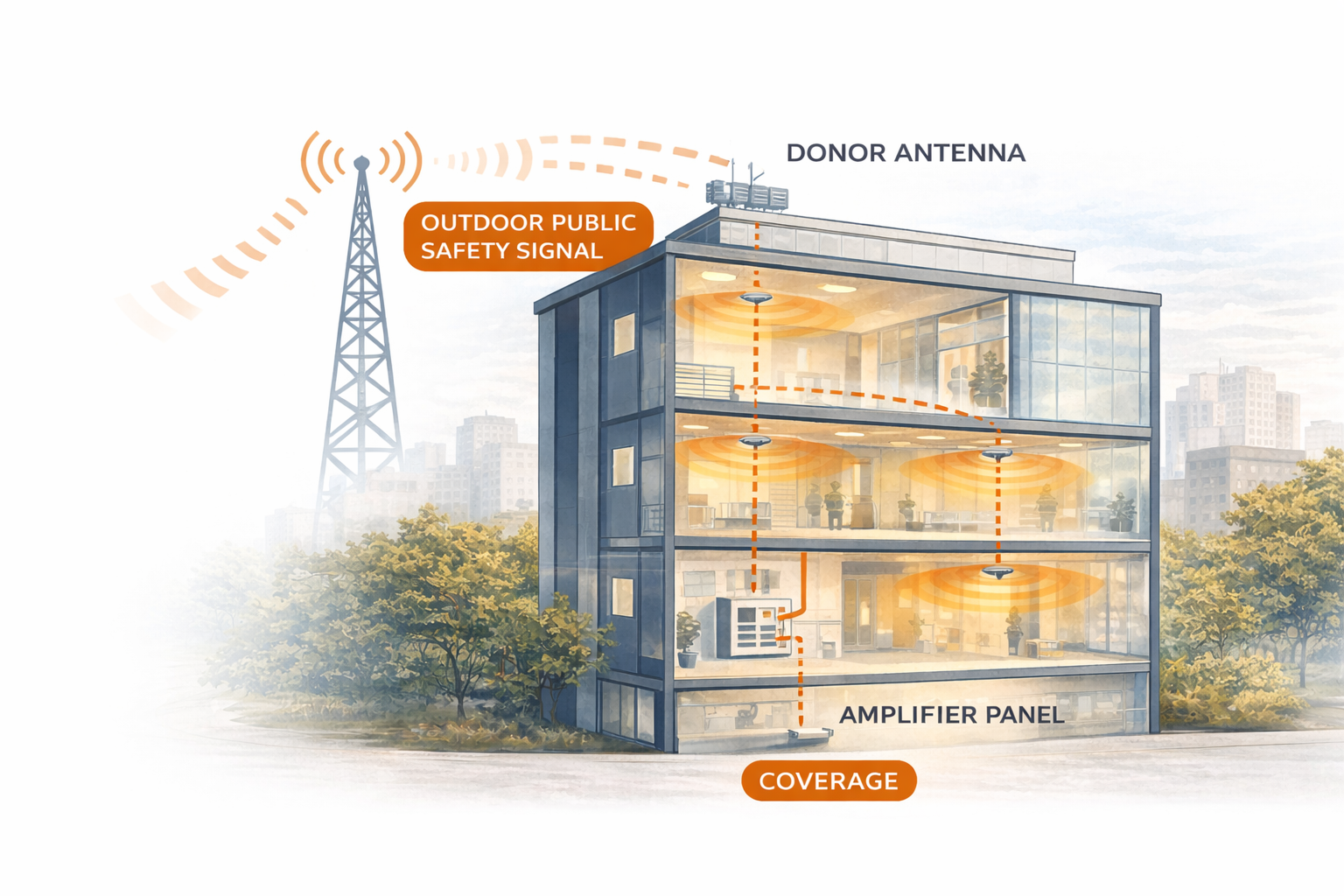
A Public Safety Distributed Antenna System (DAS) distributes public safety radio signals inside a building so first responders can communicate in areas where radio coverage may be weakened by concrete, steel, Low-E glass, underground spaces, or large floor plates.
A Public Safety DAS is often discussed alongside Emergency Responder Radio Communication System (ERRCS) and Emergency Responder Communications Enhancement System (ERCES) requirements. In many project conversations, these terms refer to the same overall goal: reliable in-building radio communication for firefighters, police, EMS, and other authorized emergency responders.
A typical system receives signal from the local public safety radio network through a donor antenna, processes that signal through a bi-directional amplifier or approved signal booster, and distributes it through indoor antennas. When a responder transmits from inside the building, the system carries that signal back toward the public safety radio network.
When testing shows that in-building radio coverage does not meet locally enforced criteria, the Authority Having Jurisdiction may require a Public Safety DAS, ERRCS or ERCES before final approval or occupancy.
For a deeper terminology breakdown, see ERRCS vs ERCES: Why Codes Use Different Terms.
Public Safety Radio Coverage Code Requirements
Public safety radio coverage requirements are typically based on adopted fire codes, NFPA standards, local amendments, AHJ policies, and the public safety radio network used in the jurisdiction.
If testing shows that emergency responder radio coverage inside the building does not meet locally enforced criteria, the AHJ may require a Public Safety DAS, ERRCS or ERCES solution before final approval or occupancy.

IFC Section 510
IFC Section 510 addresses in-building emergency responder communication coverage where adopted. The applicable edition, local amendments, fire code official direction, and public safety radio license holder requirements determine how the system must be designed, tested, and approved.

NFPA 1225
NFPA 1225 provides standards language for emergency responder communication systems, including design, installation, testing, monitoring, backup power, and maintenance considerations where adopted or referenced locally.

AHJ Requirements
The AHJ may define required frequencies, coverage criteria, critical areas, testing procedures, documentation, and acceptance requirements for the building.
Because requirements vary by location, Public Safety DAS planning should begin with local code review, AHJ coordination, public safety radio frequency confirmation, and building-specific radio coverage testing.
FCC and Public Safety Radio License Holder Coordination
Public safety BDAs and signal boosters operate on licensed public safety radio frequencies.
A building owner usually does not need to become the FCC licensee for the public safety radio system. However, a non-licensee operating a Part 90 signal booster must obtain express consent from the applicable licensee before amplifying those frequencies.
The licensee may be a city, county, state agency, regional radio authority, or another public safety radio system operator.
Class B Part 90 signal boosters must also be registered in the FCC signal booster database before operation.
For owners, this means Public Safety DAS planning should include AHJ coordination and public safety radio license holder coordination before the system is activated.
Key Components of a Public Safety DAS System
A Public Safety DAS, ERRCS or ERCES uses several coordinated components to receive, process, distribute, monitor, and maintain public safety radio coverage inside a building.
The exact equipment depends on the adopted code, AHJ requirements, public safety radio frequencies, building conditions, and test results.

Donor Antenna
The donor antenna connects the building’s DAS system to the external public safety radio network by capturing signals from nearby radio transmitters.

Cabling Infrastructure
Coaxial or fiber cabling connects DAS components and distributes amplified signals to antennas located throughout the building.

Bi-directional Amplifier (BDA)
The BDA strengthens incoming and outgoing radio signals to ensure reliable communication between first responders inside the building and public safety radio networks.

Backup Power Systems
Backup power helps keep the system operating when normal building power is disrupted. Battery runtime, generator integration, supervision, and acceptance criteria depend on the adopted code and AHJ.

Distributed Antennas
Indoor antennas are installed throughout the building to distribute radio coverage across all required areas, including stairwells, corridors, and underground spaces.

Monitoring and Alarm Systems
Monitoring equipment reports system faults that could affect emergency responder communication. Depending on local requirements, alarms may report through the building fire alarm system or another AHJ-approved supervisory method.
The Public Safety DAS Lifecycle
Public safety radio communication systems must be planned, engineered, installed, tested, and maintained around the requirements enforced by the local AHJ.
CTS supports the Public Safety DAS lifecycle from initial RF testing through design, installation, acceptance testing, documentation, maintenance, and ongoing support.

RF Grid Testing
Initial testing measures public safety radio performance throughout the building to determine whether coverage meets locally enforced criteria.

System Design
Engineers design a Public Safety DAS, ERRCS or ERCES solution around the required frequencies, coverage areas, building conditions, AHJ criteria, and equipment requirements.

System Installation
The system is installed with the required antennas, cabling, amplification or signal booster equipment, power, monitoring, and supporting infrastructure.

Acceptance Testing
System performance is verified through the testing procedure accepted by the AHJ.
AHJ Approval
Documentation and test results are submitted or reviewed as required by the AHJ before final acceptance.

Inspection & Maintenance
Ongoing inspection, testing, and maintenance help confirm that the system continues to meet the requirements enforced by the AHJ.
Technology Partners
CTS is vendor agnostic and works with leading Public Safety DAS equipment manufacturers. System requirements, AHJ direction, public safety radio frequencies, building conditions, equipment listings, and long-term support needs should determine the right equipment selection for each project.




Public Safety DAS vs Cellular DAS
Public Safety DAS and commercial cellular DAS both distribute wireless signals inside buildings, but they support different users, frequencies, networks, and approval processes.
Public Safety DAS supports emergency responder radio communication for police, fire, EMS, and other authorized agencies. Commercial cellular DAS supports mobile service for building occupants and visitors using carrier networks such as AT&T, Verizon, and T-Mobile.
A cellular DAS does not satisfy Public Safety DAS, ERRCS or ERCES requirements. A Public Safety DAS does not provide ordinary commercial cellular service. Many buildings need both systems, but they should be planned, tested, and approved separately.
Public Safety DAS / ERRCS/ERCES
Purpose
Supports reliable two-way radio communication for police, fire, EMS, incident command, and other authorized public safety users.
Radio Frequencies
Uses the local public safety radio frequencies assigned by the jurisdiction, which may include VHF, UHF, 700 MHz, 800 MHz, or other authorized public safety bands.
Code and Approval
May be required when public safety radio coverage testing shows that the building does not meet locally enforced criteria. Approval is driven by the AHJ and public safety radio stakeholders.
System Scope
May include a donor antenna, BDA or approved signal booster, distributed antennas, cabling, backup power, monitoring, alarms, testing, and documentation.
Primary Goal
Help first responders maintain reliable radio communication inside the building during an emergency.
Cellular DAS
Purpose
Improves commercial mobile connectivity for employees, tenants, residents, patients, visitors, vendors, customers, and facility teams.
Radio Frequencies
Uses licensed commercial carrier bands for voice, text, LTE, 5G, and mobile data services. Supported bands vary by carrier, market, signal source, and system design.
Code and Approval
Generally not a fire code requirement. Approval and performance expectations are tied to participating carriers, project stakeholders, and the building’s connectivity goals.
System Scope
May use an off-air donor signal or a direct carrier-connected signal source, along with headend equipment, fiber or coax infrastructure, remote units, and indoor antennas.
Primary Goal
Provide reliable commercial cellular service for everyday building operations, occupant experience, and mobile application access.
Cellular DAS systems do not replace Public Safety DAS, ERRCS or ERCES requirements. When public safety radio coverage does not meet locally enforced criteria, the AHJ may require a dedicated emergency responder communication system designed for the jurisdiction’s public safety radio frequencies.
For a detailed comparison, see Public Safety DAS vs Cellular DAS: Key Differences.
PUBLIC SAFETY BY INDUSTRY
Public Safety DAS for Complex Building Environments
Public safety radio coverage is not one-size-fits-all. Building materials, size, layout, below-grade spaces, parking structures, and local code requirements can all affect how an ERRCS or Public Safety DAS must be designed, tested, and maintained. CTS supports public safety radio systems across complex enterprise environments nationwide.

Commercial Real Estate
High-rises, mixed-use properties, parking structures, stairwells, and tenant spaces can create complex first responder coverage needs.
Explore Commercial Real Estate
Data Centers
Dense construction, secure rooms, power infrastructure, and restricted spaces can complicate reliable emergency radio coverage.
Explore Data Centers
Education
Multi-building campuses, residence halls, academic buildings, arenas, and parking structures require coordinated coverage planning.
Explore Education
Healthcare
Hospitals and medical campuses combine large footprints, dense construction, basements, and critical back-of-house areas.
Explore Healthcare
Hospitality
Guest towers, event spaces, service corridors, back-of-house areas, and garages can create challenging radio coverage conditions.
Explore Hospitality
Logistics
Large warehouses, distribution centers, loading areas, yards, and high-rack environments can create difficult coverage conditions.
Explore Logistics
Manufacturing
Concrete, steel, machinery, production areas, and large industrial footprints can complicate in-building radio propagation.
Explore Manufacturing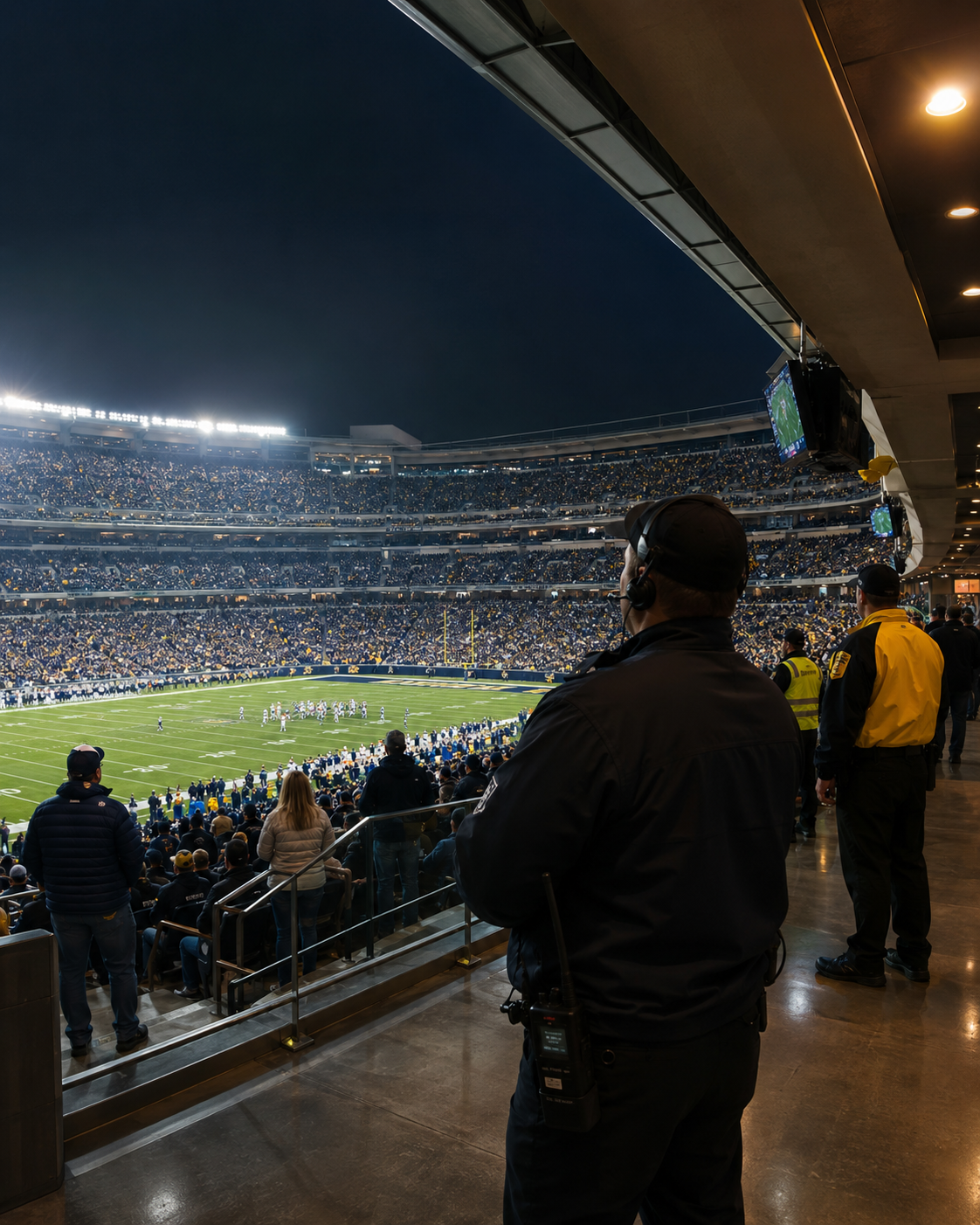
Stadiums & Venues
Seating bowls, concourses, service areas, back-of-house spaces, and parking structures create coverage challenges at venue scale.
Explore Stadiums & Venues
Transportation
Airports, ports, terminals, garages, and operational areas require coverage across large, complex, high-traffic facilities.
Explore TransportationPlan Public Safety DAS Early in the Building Design Process
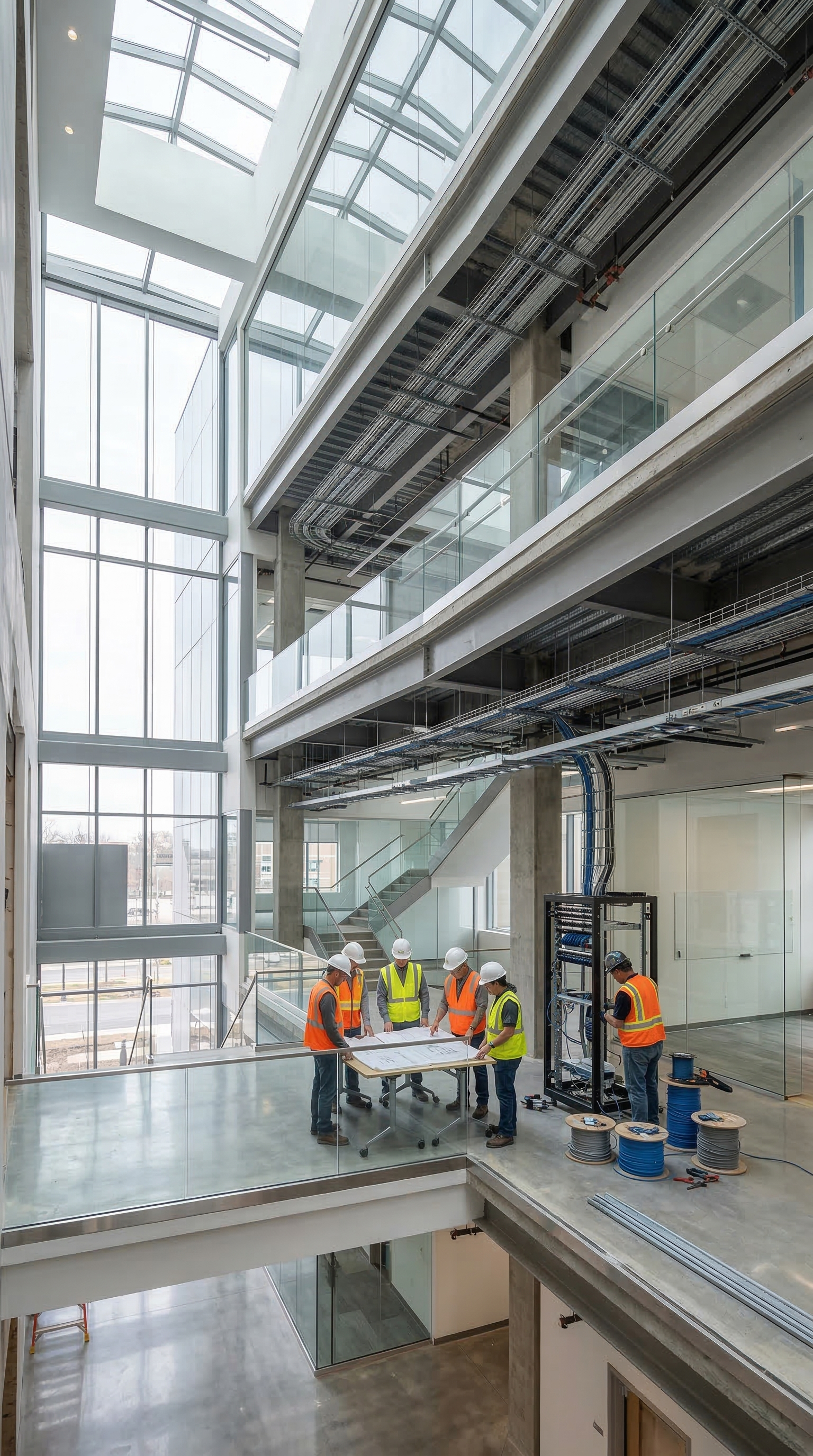
Public safety radio coverage issues are often discovered late in construction, when testing shows that emergency responder radio communication does not meet locally enforced criteria.
When coverage issues are identified late, a Public Safety DAS, ERRCS or ERCES can require new cabling pathways, equipment space, rooftop access, power, backup power, fire alarm coordination, and antenna placement.
Benefits of early planning include:
Reduced risk of failed radio coverage inspections
Avoidance of costly post-construction retrofits
Improved coordination with building infrastructure
Smoother AHJ review and acceptance process
Late Discovery Can Delay Occupancy
If public safety radio coverage testing fails late in a project, the AHJ may require corrective work before final approval or occupancy. That can create schedule, budget, and coordination challenges near the end of construction.
Projects may face:
Failed radio coverage inspection
Certificate of Occupancy delays
Tenant move-in disruption
New cabling, pathway, power, or antenna requirements
Expensive retrofits after construction
Learn more about how Public Safety DAS requirements can affect Certificate of Occupancy.
Affiliations Supporting Public Safety Communications
CTS actively participates in organizations supporting the advancement of public safety communications and in-building emergency responder radio coverage.
Public Safety DAS Resources
-
Data Sheet
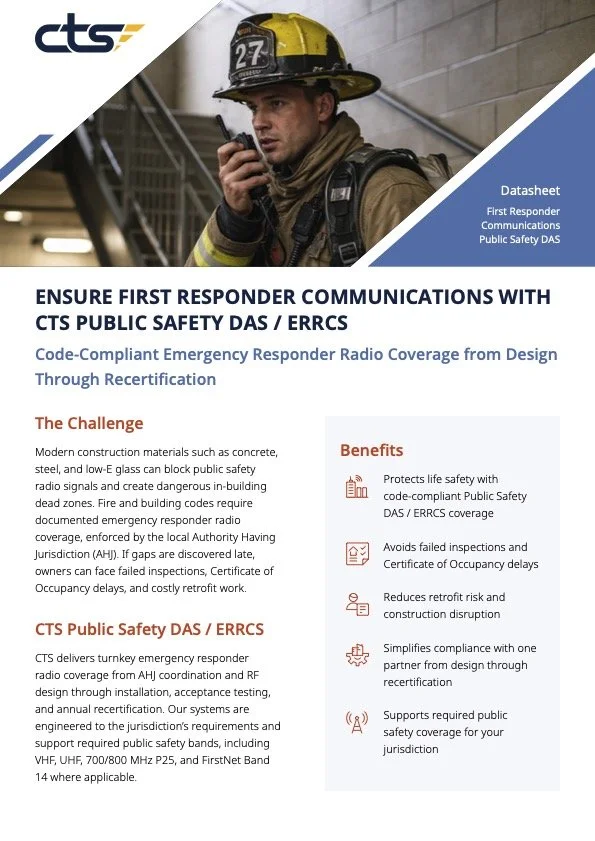
Learn more about the CTS Public Safety DAS solution.
-
Brochure
Learn more about the complete portfolio of CTS connectivity solutions.
Public Safety DAS Insights
Explore guides and insights on Public Safety DAS, ERRCS, ERCES, code requirements, testing, occupancy risk, and the differences between public safety and commercial cellular DAS.
Public Safety DAS, ERRCS and ERCES: What Building Owners Need to Know
Understand how Public Safety DAS, ERRCS and ERCES relate, how these systems support first responder radio communication, and why AHJ coordination, testing, backup power, and maintenance matter for building teams.
Read the GuideDo I Need a Public Safety DAS?
Learn when a building may need a Public Safety DAS, how in-building radio coverage is evaluated, and why testing should be planned before final inspection or occupancy.
Read the InsightERRCS vs ERCES: Why Codes Use Different Terms
Compare ERRCS, ERCES, ERRC, Public Safety DAS, and BDA terminology so project teams can align code language, procurement scope, and AHJ expectations.
Read the InsightPublic Safety DAS vs Cellular DAS: Key Differences
See how Public Safety DAS and commercial cellular DAS differ by users, frequencies, networks, signal sources, approval processes, testing, and occupancy risk.
Read the GuideBuildings Most Likely to Need a Public Safety DAS
Review the building types and conditions most commonly associated with public safety radio coverage issues, including large facilities, high-rises, below-grade areas, and complex structures.
Read the InsightPublic Safety DAS Requirements Can Affect Certificate of Occupancy
Learn how failed public safety radio coverage testing can create late-stage construction risk, including inspection issues, rework, and Certificate of Occupancy delays.
Read the InsightPublic Safety DAS Frequently Asked Questions
-
A Public Safety DAS, ERRCS or ERCES is an in-building emergency responder radio coverage system that helps firefighters, police officers, EMS teams, and other authorized first responders maintain reliable two-way radio communication inside a building.
Public Safety DAS usually refers to the distributed antenna and cabling infrastructure. ERRCS and ERCES are terms used for the broader emergency responder communication system. The terminology may vary by code edition, project document, and Authority Having Jurisdiction.
-
Public Safety DAS may be required when public safety radio coverage testing shows that the building does not meet the criteria enforced by the local Authority Having Jurisdiction.
Requirements vary by adopted code, local amendment, AHJ policy, public safety radio frequencies, building conditions, and test results. The AHJ determines whether a Public Safety DAS, ERRCS or ERCES is required for a specific building.
-
Public Safety DAS, ERRCS and ERCES requirements are commonly tied to adopted editions of the International Fire Code, National Fire Protection Association standards such as NFPA 1225, local amendments, AHJ policies, and equipment listing requirements where applicable.
The locally adopted code and AHJ determine what applies to a specific building.
-
ERRCS and ERCES generally describe the same type of in-building emergency responder communication system.
ERRCS is commonly used in permitting, construction, fire marshal discussions, RF testing reports, and owner conversations. ERCES is increasingly associated with current code and standards language. The preferred term depends on the adopted code, local amendments, project documents, and AHJ.
-
Public safety radio coverage testing measures whether first responder radios can communicate reliably in the areas required by the AHJ.
Testing may evaluate signal strength, uplink and downlink performance, delivered audio quality, critical areas, and general building coverage. The procedure, test equipment, documentation, and acceptance criteria vary by jurisdiction.
-
If a building fails public safety radio coverage testing, the AHJ may require corrective work before final approval or occupancy.
Corrective work may include a Public Safety DAS, ERRCS or ERCES, additional testing, design review, equipment installation, backup power, monitoring, documentation, and AHJ-witnessed acceptance.
-
No. Public Safety DAS and commercial cellular DAS are different systems.
Public Safety DAS supports emergency responder radio communication for police, fire, EMS, and other authorized agencies. Cellular DAS supports mobile service for building occupants and visitors using carrier networks such as AT&T, Verizon, and T-Mobile.
A cellular DAS does not satisfy Public Safety DAS, ERRCS or ERCES requirements. A Public Safety DAS does not provide ordinary commercial cellular service.
-
Usually, the building owner does not need to become the FCC licensee for the public safety radio system.
However, a non-licensee operating a Part 90 signal booster must obtain express consent from the applicable public safety radio license holder before amplifying those frequencies. Class B Part 90 signal boosters must also be registered with the FCC before operation.
-
Public Safety DAS cost depends on building size, construction materials, number of floors, below-grade areas, required frequencies, donor signal conditions, equipment requirements, backup power, monitoring, pathways, AHJ requirements, and testing scope.
A site assessment and RF testing are usually needed before the project team can define the required system and budget.
-
Public Safety DAS approval is usually coordinated by the project team, system designer, integrator, owner, contractor, and local AHJ.
CTS supports AHJ coordination, RF testing, system design, installation, acceptance testing, documentation, maintenance, and ongoing support for Public Safety DAS, ERRCS and ERCES projects.
Support Reliable Public Safety Radio Coverage in Your Building
CTS helps building owners, developers, contractors, and engineers evaluate, design, deploy, test, and support Public Safety DAS, ERRCS and ERCES solutions aligned with adopted code requirements, AHJ criteria, and public safety radio network conditions.
Our team supports every stage of the process, including RF testing, system design, installation, acceptance testing, documentation, maintenance, and ongoing support.
IFC Section 510 • NFPA 1225 • AHJ Coordination • Nationwide Deployment