
MANAGED SIGNAL SOURCE FOR ENTERPRISE DAS

Forte Neutral Source for Reliable Multi-Carrier DAS in Enterprise Buildings
Forte Neutral Source provides a managed signal source for enterprise DAS deployments, helping building owners and infrastructure teams coordinate carrier access, reduce source-layer uncertainty, support timely activation, and maintain reliable multi-carrier performance over the network lifecycle.
Managed Signal Source • Multi-Carrier DAS
Carrier Coordination • Activation & Lifecycle Support
QUICK ANSWER
WHAT IS FORTE NEUTRAL SOURCE?
Forte Neutral Source is a managed, multi-carrier signal source service for enterprise DAS deployments. It feeds a DAS with carrier-approved cellular signal so the DAS has a reliable source to distribute throughout the building or campus. Forte helps owners and infrastructure teams reduce approval friction, avoid fragmented carrier-by-carrier sourcing, and support long-term indoor cellular performance.

Over 100 Forte Deployments
Forte is already deployed across real enterprise environments, not limited to pilot projects or one-off use cases.

AT&T, Verizon, and T-Mobile
Forte supports coordinated access to the three major U.S. mobile carriers for multi-carrier DAS deployments.

Compatible with major DAS OEM solutions
Forte feeds the DAS signal source layer without forcing a single equipment vendor or proprietary DAS platform.

Stiles 110 East
Forte helped support multi-carrier indoor cellular coverage before tenant occupancy at a Class A+ office tower in Charlotte.
Why Signal Source Strategy Matters for Enterprise Indoor Cellular
Many indoor cellular projects do not fail because of antenna placement alone. They stall, underperform, or become difficult to support because the signal feeding the DAS is weak, inconsistent, delayed by carrier approvals, or not clearly managed after activation.
That creates real business risk. For a building owner, signal-source delays can affect occupancy readiness, tenant experience, lease commitments, and project closeout. For enterprise IT and facilities teams, they can create stakeholder frustration and long-term operational exposure. The DAS may be designed correctly, but if the source layer is not approved, stable, and supportable, the indoor cellular experience will not meet expectations.
Common signal-source challenges include:
Carrier-by-carrier approval bottlenecks that extend project timelines
Uncertainty around donor signal quality, rooftop access, or macro network conditions
Fragmented coordination across carriers, vendors, construction teams, and operations teams
Limited accountability when nobody clearly owns source performance after activation
Expensive reactive changes when carrier requirements evolve or source quality degrades
Forte addresses the part of the DAS project that is often hardest to control: securing and managing the carrier-connected signal source that the DAS depends on. For an existing DAS, changes in carrier requirements or signal-source strategy can also introduce broader lifecycle and supportability risk, even when the system is still operating.

Forte Neutral Source as the Managed Signal Source for DAS
Forte Neutral Source is the managed signal-source layer that feeds a DAS with carrier-connected cellular signal. It is not a replacement for DAS. The DAS still distributes cellular signal through antennas, cabling, remotes, and headend infrastructure. Forte provides the source layer that helps make the DAS useful, approved, and supportable for multi-carrier indoor coverage.
This distinction matters. DAS infrastructure alone does not create carrier signal. It distributes signal from a source. If that source is delayed, weak, unmanaged, or dependent on outdoor conditions, the building may still experience poor indoor cellular performance.
Forte gives enterprise stakeholders a structured alternative to signal-source strategies that can be hard to scale or hard to manage across AT&T, Verizon, and T-Mobile.
The table below compares common signal-source approaches for enterprise DAS projects.
A DAS can only distribute the signal it receives. The source strategy determines whether the system depends on outdoor macro signal, separate carrier-by-carrier sourcing, or a managed multi-carrier source layer designed for enterprise DAS performance.
| Approach | How signal is sourced | Main risk | Best fit |
|---|---|---|---|
| Repeater / booster | Amplifies existing outdoor signal indoors | Source quality, noise, limited scale, and weaker fit for complex multi-carrier environments | Smaller or simpler spaces with usable outdoor signal |
| Off-air donor source for DAS | Pulls outdoor macro signal into the DAS through donor infrastructure | Approval uncertainty, signal variability, and long-term source risk | Select deployments where donor conditions are strong and stable |
| Fragmented carrier-by-carrier sourcing | Each carrier is coordinated and sourced separately | Delays, complexity, inconsistent timelines, and unclear accountability | Difficult to scale across enterprise projects |
|
Forte Neutral Source
Managed Source Layer |
Managed signal source feeding DAS with coordinated carrier access | Requires early planning and structured project coordination | Mid-size and large enterprise buildings needing predictable multi-carrier performance |
Repeater / booster
Off-air donor source for DAS
Fragmented carrier-by-carrier sourcing
Forté Neutral Source
Forte does not remove the need for good DAS design. It strengthens the source strategy that the DAS depends on.
How Forte Neutral Source Works
Forte brings the signal-source layer into the project as a managed service instead of treating it as a loose collection of carrier approvals, donor conditions, and one-time equipment decisions. The result is a more accountable signal path from carrier-connected source to DAS distribution.
Carrier-connected source layer
Forte provides the carrier-connected radio source that brings managed cellular signal into the building. The source layer is planned around carrier coordination, backhaul, power, network infrastructure, and operational oversight.
Monitoring and lifecycle management
Carrier alignment does not end at activation. Forté supports monitoring, coordination, optimization, and change management as carrier requirements and building conditions evolve.
Integration into the DAS
Forte feeds the DAS. It does not replace the DAS. The DAS remains the in-building distribution system, carrying cellular signal through the headend, distribution network, and antenna infrastructure.
Coordination with project stakeholders
Forte fits into projects involving owners, IT teams, facilities teams, EC/GC teams, DAS partners, carrier representatives, and OEM partners as the managed signal-source layer.
DAS Lifecycle Risk
What Happens When the Signal Source or Carrier Requirements Change?
A DAS can remain operational even as carrier requirements, signal-source strategies, equipment support and network technologies change around it. For organizations with an existing DAS, those changes can create lifecycle risk that extends beyond the signal source itself. A DAS Lifecycle Risk Review can help determine whether the current system should be maintained, remediated, enhanced, planned for future transition or replaced.
Forte Neutral Source Use Cases and Outcomes
Forte is most relevant where indoor cellular performance is business-critical and the DAS needs a predictable, managed, multi-carrier signal source.
Class A office and mixed-use developments
Commercial real estate projects cannot treat cellular coverage as a post-occupancy complaint. Tenants expect reliable service on day one, and owner-operators need confidence that the building can support multi-carrier connectivity across offices, amenity areas, parking levels, and common spaces.
Forte is a strong fit when carrier-direct timelines could put occupancy readiness at risk or when fragmented source strategies would complicate delivery. At Stiles 110 East in Charlotte, Forte helped support guaranteed multi-carrier indoor coverage before tenant move-in, giving the owner a clearer path to tenant-ready connectivity.
Healthcare and education facilities
Hospitals, medical office buildings, universities, and campus environments often include dense construction, multiple buildings, below-grade areas, and high user expectations. Cellular coverage supports clinical communication, student and staff connectivity, operations teams, visitors, and contractors.
Forte can help these environments avoid source-layer uncertainty when a DAS is needed across complex spaces and multiple carriers must be supported over time.
Corporate and industrial campuses
Corporate campuses, manufacturing sites, warehouses, and logistics environments often require reliable cellular for workforce communication, mobility tools, IoT devices, access systems, and operational visibility.
Forte supports DAS projects where the coverage footprint, carrier mix, or operational requirements make basic repeater or donor-based approaches a weaker fit. It gives the enterprise a managed signal source strategy that can support long-term operations instead of a one-time coverage patch.
Civic and municipal buildings
Civic buildings and municipal facilities often involve multiple stakeholders, formal project schedules, and long operating lifecycles. They need a signal-source approach that supports accountability after the project is complete.
Forte helps clarify source-layer ownership, reduce coordination complexity, and support indoor cellular performance in buildings where public users, staff, and operations teams all depend on reliable connectivity.
Transportation hubs and public venues
Transportation hubs, stadiums, convention centers, and public venues place heavy demands on indoor and campus cellular systems. They often combine high density, large coverage areas, variable traffic patterns, and complex stakeholder coordination.
Forte can support DAS deployments where carrier coordination and source reliability are central to performance, especially when the environment cannot depend on outdoor macro signal or fragmented carrier-by-carrier sourcing.
Hospitality and convention-oriented properties
Hotels, conference centers, resorts, and event properties depend on indoor cellular service for guests, staff, meetings, vendors, and building operations. Poor coverage can affect experience, event execution, and property reputation.
Forte gives these properties a managed source option for DAS projects that need multi-carrier coverage across rooms, meeting spaces, ballrooms, service corridors, parking areas, and public zones.
How CTS Designs and Deploys Forte Neutral Source
CTS approaches Forte as part of the complete in-building cellular lifecycle. The goal is to define the right source strategy early, align it with the DAS design, coordinate the required carrier path, and manage the source layer after activation.

Assess
CTS evaluates the building environment, coverage goals, user density, traffic expectations, carrier requirements, project schedule, and where DAS is needed. This step helps determine whether Forte is the right source strategy or whether another signal-source path is more appropriate.

Design the Source Strategy
CTS defines how Forte will support the DAS architecture. This includes source-layer requirements, backhaul considerations, equipment locations, power needs, carrier coordination requirements, and integration points with the DAS.
The source strategy must match the building, not the other way around.

Coordinate Carrier Access
CTS helps align carrier requirements, approvals, technical inputs, and deployment readiness through a structured process. This reduces the fragmentation that can occur when each carrier path is handled separately without a unified source strategy.

Optimize
CTS reviews performance trends and coordinates adjustments as carrier requirements, building usage, and coverage expectations evolve. This helps protect the DAS investment and keep the signal-source strategy aligned with long-term building needs.

Manage
After activation, CTS continues to support source performance, carrier alignment, monitoring, issue response, and lifecycle changes. This is where Forté differs from equipment-only approaches. The signal-source layer remains part of a managed operating model, not a one-time procurement decision.

Deploy
CTS integrates the Forte source layer with the DAS and prepares the system for live operation. Deployment coordination accounts for building access, construction schedules, DAS integration, carrier activation needs, and operational handoff.
REAL WORLD RESULTS
Stiles 110 East: Multi-Carrier Coverage Before Tenant Occupancy
Stiles needed reliable indoor cellular coverage ready before tenants moved into 110 East, a Class A+ office tower in Charlotte. Waiting on fragmented carrier-by-carrier signal source timelines would have created uncertainty around occupancy readiness, tenant experience, and project closeout.
Forte Neutral Source gave the project a managed multi-carrier signal source strategy feeding the DAS, helping support reliable indoor coverage on a predictable schedule. The result was a clearer path to tenant-ready cellular service, with signal source coordination, DAS integration, and ongoing accountability aligned from the start.
Forte Neutral Source Resources
-

Signal Source Strategy Whitepaper
Learn how signal source strategy determines DAS performance, deployment timelines, carrier coordination, and long-term in-building cellular outcomes.
-

Forte Neutral Source Data Sheet
Get a concise overview of Forte Neutral Source, including how the managed signal source service feeds enterprise DAS deployments and supports multi-carrier coverage.
-
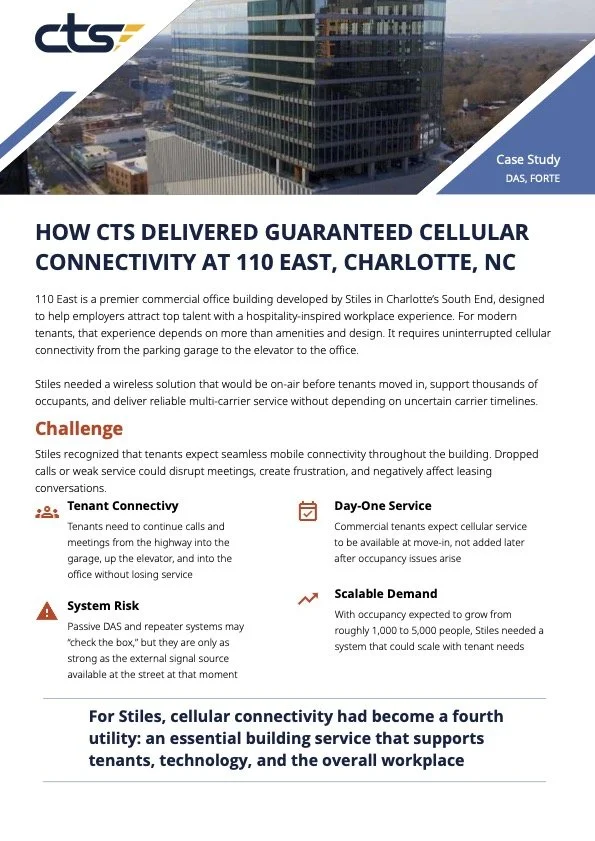
Stiles 110 East Customer Story
See how a Class A+ office tower supported tenant-ready multi-carrier indoor cellular coverage with Forte Neutral Source.
Forte Neutral Source Insights
Why DAS Signal Source Matters →
Understand how the source layer affects DAS performance, project predictability, carrier support, and enterprise coverage outcomes.
The Future of In-Building Cellular Starts With Signal Source Innovation →
Explore how managed signal-source models are changing the way enterprise buildings approach indoor cellular strategy.
What Happens When a Carrier Shuts Down a DAS Signal Source? →
Learn how carrier signal-source shutdowns can affect an existing DAS, what risks to evaluate, and how to plan the next step before service is disrupted.
Learn how CTS evaluates DAS, standalone small cells, and managed signal sources as part of an architecture-neutral in-building cellular strategy.
Forte Partner Path
Are you a DAS integrator or distributor? Visit the Forte partner site for channel-specific technical documentation, program details, and partner resources.
Forte Neutral Source Frequently Asked Questions
-
Forte Neutral Source is a managed, multi-carrier signal source service for enterprise DAS deployments. It feeds the DAS with carrier-connected cellular signal so the DAS can distribute that signal throughout the building. Forté is not a DAS replacement. It is the managed source layer that helps the DAS perform reliably.
-
A repeater, booster, or off-air donor source depends on usable outdoor macro signal. That can work in simpler buildings, but source quality, noise, and long-term reliability can become issues. Forte uses a managed carrier-connected source model for DAS, reducing dependence on outdoor donor conditions and creating clearer accountability for source performance.
-
Yes. Forte supports multi-carrier DAS deployments involving AT&T, Verizon, and T-Mobile. The value is not only carrier access. It is the structured coordination, technical alignment, and managed source-layer support that helps enterprise teams avoid fragmented carrier-by-carrier sourcing.
-
Forte is compatible with major DAS OEM solutions and does not force a single equipment vendor. The DAS design can still be selected based on the building’s requirements, coverage goals, pathways, headend strategy, and long-term operating model. Forté supports the source layer that feeds that DAS.
-
Forte should be evaluated early in the DAS planning process, before the project depends on uncertain carrier timelines or donor-source assumptions. Early source planning helps align the DAS design, carrier coordination, backhaul, equipment locations, cost model, and schedule before deployment decisions are locked in.
-
Forte is structured as a managed service rather than a one-time hardware purchase. The model supports a predictable subscription structure that can include carrier coordination, source-layer support, monitoring, and lifecycle management. Exact pricing depends on the building, carrier requirements, DAS architecture, and project scope.
-
CTS manages the Forte signal-source layer after deployment as part of the service model. That includes monitoring, carrier coordination, issue response, optimization, and lifecycle support. The goal is to avoid the common problem where the DAS is installed, but nobody clearly owns source performance over time.
-
Yes. Forte can work within broader project structures that include other DAS installers, EC/GC teams, DAS partners, and OEM partners. On the CTS site, the page is written for enterprise buyers first, but Forté also supports projects where CTS is responsible for the managed source layer within a larger delivery team.
Ready to Improve Indoor Cellular Performance with a Better Signal Source Strategy?
Enterprise indoor cellular performance depends on more than DAS hardware alone. A DAS needs a reliable, approved, and managed signal source to deliver the coverage experience building users expect.
Forte Neutral Source gives owners and project teams a managed source strategy designed to reduce approval friction, improve accountability, and support multi-carrier coverage over the full lifecycle of the deployment.