
Why Private 5G Is Emerging in Healthcare Connectivity Strategies
Healthcare organizations are re-evaluating their network infrastructure as digital care models, connected devices, and real-time data demands continue to expand.
Private 5G in healthcare is a dedicated, on-premise wireless network that gives organizations full control over connectivity, performance, and security across clinical environments.
Traditional Wi-Fi networks alone were not designed to support the mobility, device density, and performance requirements of modern healthcare environments, leading organizations to evaluate more controlled connectivity models.
As a result, healthcare organizations are shifting from shared wireless environments to dedicated network models that provide greater control over performance, security, and device connectivity.
As healthcare delivery becomes more digital and distributed, networks must support a growing number of connected devices, mobile workflows, and data-intensive applications. Performance gaps in these environments can impact clinical operations, communication, and patient experience.
Healthcare organizations are increasingly investing in infrastructure that provides consistent, scalable connectivity across facilities, while supporting the performance and security requirements of modern clinical environments.
- Private 5G enables secure, high-performance connectivity across healthcare environments, supporting real-time clinical applications and high device density.
- Dedicated wireless infrastructure gives organizations greater control and scalability, helping future-proof networks for IoT, AI, and evolving care delivery models.
Security and Control Are Foundational Requirements

Healthcare networks must meet strict compliance standards while supporting a growing number of connected devices, users, and applications.
Private 5G enables a more controlled connectivity environment by allowing organizations to manage network access, performance, and data flow internally.
Key capabilities include:
Dedicated network infrastructure with isolated traffic environments
Support for zero-trust security frameworks across devices and users
Fine-grained control over network access and prioritization
Alignment with HIPAA and broader healthcare security requirements
Unlike public cellular or shared wireless environments, private 5G allows healthcare organizations to control how traffic is prioritized, segmented, and secured across devices and applications. This level of control allows healthcare organizations to define how devices, users, and applications interact with the network, ensuring that critical systems receive prioritized and protected connectivity.
Performance and Reliability Support Critical Care Environments
Healthcare operations depend on real-time communication and uninterrupted connectivity.
Private 5G networks are designed to support:
Low-latency communication for clinical applications and decision-making
High device density for IoT, medical equipment, and mobile staff workflows
Consistent performance across large facilities and campuses
Reliable connectivity for mission-critical systems and emergency response
Private 5G enables more predictable and consistent network performance, allowing healthcare organizations to prioritize critical applications and ensure reliable connectivity in environments where delays or disruptions can impact care delivery.
This is particularly important in healthcare environments where delays in data transmission or communication can directly impact clinical decision-making and patient outcomes.

Private 5G Extends Connectivity Across Complex Facilities
Hospitals and healthcare campuses often include environments where traditional wireless networks struggle to maintain consistent performance. Hospitals and healthcare campuses often include environments where traditional wireless networks struggle to maintain consistent performance. Private 5G enables reliable, high-performance connectivity across these complex environments, supporting both indoor and outdoor operations.
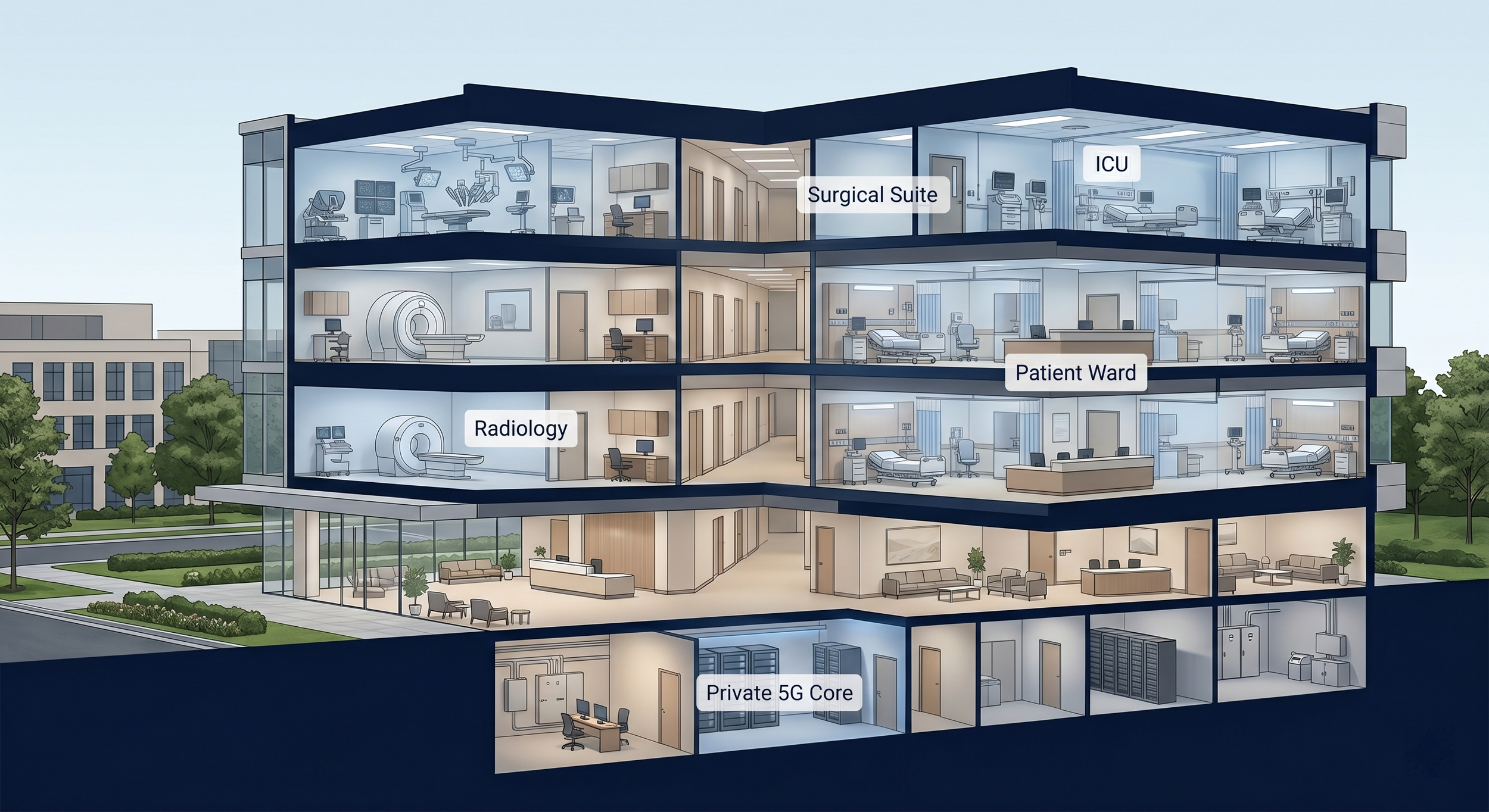
Hospitals and healthcare campuses often include environments where traditional wireless solutions struggle to perform consistently.
Private 5G can enhance coverage and performance in:
Large hospital campuses with dense construction materials
Research facilities and specialized care environments
Outdoor-to-indoor transitions across medical campuses
Temporary or rapidly deployed care sites
When integrated as part of a broader connectivity strategy, private 5G provides a controlled, scalable network layer that supports consistent performance across diverse clinical and operational environments.
Strategic Infrastructure Supports Emerging Healthcare Use Cases
Healthcare delivery is evolving to include more connected, data-driven, and distributed models of care.
Private 5G supports:
Connected medical devices and IoT ecosystems
Remote monitoring and telehealth applications
AI-driven diagnostics and real-time data processing
Autonomous systems and advanced clinical workflows
These use cases often require consistent, low-latency connectivity and the ability to support large numbers of devices simultaneously. Private 5G provides the network foundation needed to support these demands without compromising performance or security.
The Outcome Is Operational, Not Just Technical
Connectivity investments in healthcare are measured by their operational impact. Private 5G enables predictable network performance, supports application prioritization, and provides greater control over how devices and systems connect.
These capabilities improve clinical coordination, accelerate access to data, and create infrastructure that can adapt as healthcare delivery evolves.
Private 5G enables:
More reliable clinical communication and coordination
Faster access to data for care teams
Improved patient experience through consistent connectivity
Infrastructure that adapts to evolving care delivery models
As healthcare systems grow more complex, network performance becomes directly tied to outcomes and efficiency.
Private 5G and Existing Healthcare Network Infrastructure
Healthcare connectivity environments are rarely built on a single technology. Private 5G is most effective when integrated with existing systems such as Wi-Fi and in-building wireless solutions, creating a layered approach to connectivity.
In this model:
Wi-Fi supports general connectivity and administrative workflows
In-building wireless systems provide consistent indoor cellular coverage
Private 5G provides dedicated, high-performance connectivity for critical applications and devices
This integrated approach allows healthcare organizations to align network capabilities with specific use cases, improving performance while maintaining flexibility across environments.
Planning for Private 5G in Healthcare Environments
Organizations typically begin evaluating private 5G when existing wireless networks cannot consistently support critical applications, high device density, or performance requirements across their facilities. Healthcare organizations evaluating private 5G should focus on how it aligns with existing infrastructure and long-term goals.
Private 5G is typically deployed alongside existing infrastructure such as Wi-Fi and Distributed Antenna Systems, complementing these technologies rather than replacing them.
Key considerations include:
Identifying high-impact use cases where performance improvements are critical
Evaluating current wireless limitations across facilities
Aligning private 5G with security, compliance, and IT governance frameworks
Integrating private 5G with existing systems such as DAS, Wi-Fi, and core networks
CTS works with healthcare organizations to assess environments, define use cases, and design private 5G solutions aligned with clinical and operational requirements.
Early-stage planning ensures that private 5G deployments deliver measurable value while supporting long-term scalability.
Related Resources
Healthcare Connectivity Solutions
Explore in-building wireless solutions designed to improve cellular coverage across healthcare environments.
Private Cellular Network Solutions
Explore private cellular network solutions designed to improve mission critical connectivity across healthcare environments.
Why Cellular Coverage in Hospitals Is Failing
Learn why hospitals often struggle with weak indoor cellular signal and how building materials affect wireless coverage.
How Hospitals Are Solving Cellular Coverage Problems with DAS and Private Networks
Explore the technologies hospitals are deploying to deliver reliable connectivity across healthcare campuses.
Frequently Asked Questions
-
Private 5G in healthcare is a dedicated wireless network that provides secure, high-performance connectivity within hospitals and medical campuses. Unlike public cellular networks, private 5G gives healthcare organizations full control over network access, performance, and data, supporting critical clinical applications and connected devices.
-
Private 5G offers greater reliability, security, and scalability compared to traditional Wi-Fi networks. It supports higher device density, provides more consistent performance in complex environments, and enables better control over network traffic, making it well-suited for mission-critical healthcare operations.
-
Private 5G in healthcare is a dedicated, on-premise wireless network that provides secure, high-performance connectivity for hospitals, clinics, and medical devices.
-
Yes, private 5G is typically deployed alongside existing infrastructure such as Wi-Fi and in-building wireless systems. It complements these technologies by providing dedicated, high-performance connectivity for specific use cases, rather than replacing existing networks entirely.
-
Private 5G is well-suited for use cases that require reliable, real-time connectivity, including connected medical devices, remote patient monitoring, telehealth, imaging data transfer, and advanced clinical workflows. It is especially valuable in large or complex healthcare environments.
-
Private 5G networks are designed with security and control in mind. They support advanced security frameworks such as network segmentation and controlled access, helping healthcare organizations meet compliance requirements while protecting sensitive patient data.
Planning a Healthcare Private 5G Deployment?
CTS works with healthcare organizations to assess connectivity environments, identify performance gaps, and design infrastructure aligned with clinical operations.
Connect with our team to evaluate your current network and plan your next phase of healthcare connectivity.
CTS designs and deploys healthcare DAS systems for hospitals and medical campuses across the United States.