
PRIVATE CELLULAR NETWORKS

Private Cellular Networks for Enterprise Operations
CTS designs, deploys, and manages private LTE and private 5G networks using CBRS, licensed spectrum, and neutral host architectures for enterprise environments where wireless coverage, mobility, security, and control are critical to operations.
QUICK ANSWER
WHAT IS A PRIVATE CELLULAR NETWORK?
A private cellular network is a dedicated 4G LTE or 5G wireless network deployed for a specific organization, facility, or campus. Unlike public cellular networks, which are operated by mobile carriers and shared by many users, a private cellular network is designed around one organization’s devices, applications, users, and coverage requirements.
Private cellular networks use licensed or lightly licensed spectrum, most commonly CBRS in the United States, and SIM-based access control to provide secure, managed wireless connectivity for enterprise operations. They are often used when Wi-Fi cannot reliably support wide-area coverage, continuous mobility, high-density IoT, OT segmentation, or performance-sensitive applications.
CTS designs, deploys, and manages private cellular networks for enterprise facilities, from single-building deployments to multi-site campus environments.

Back-to-Back OnGo Alliance Awards
CTS won the 2022 Neutral Host Architecture/Solution Award and the 2023 OnGo Device Innovation Award, recognizing CBRS-based enterprise wireless innovation.

Semiconductor Fab Private 5G
CTS delivered a 5G Standalone network over OnGo CBRS spectrum for a global semiconductor manufacturer, supporting IoT, safety monitoring, access security, and precision logistics.

Vendor and Architecture Neutral
CTS evaluates CBRS, licensed spectrum, private LTE, private 5G, and MOCN neutral host architectures before recommending a design.

Fully Managed Operations
CTS monitors and manages private cellular networks through its Network Operations Center, including performance monitoring, spectrum management, maintenance, and lifecycle support.
When Private Cellular Is the Right Fit
Private cellular is a fit when wireless connectivity has a direct impact on operations, safety, automation, security, or productivity. It is not a replacement for every Wi-Fi use case. It is a dedicated wireless layer for environments where standard enterprise Wi-Fi or public cellular service cannot provide the coverage, control, mobility, or predictability the business requires.
| Your environment needs | Why private cellular may fit |
|---|---|
| Large indoor, outdoor, or mixed-use coverage | Private cellular can often cover large operational areas with fewer radio locations than a comparable Wi-Fi design, depending on capacity, RF conditions, and device requirements. |
| Continuous mobility for AGVs, AMRs, vehicles, or mobile workers | Cellular handoffs are designed for devices in motion, which can reduce interruptions for mobile workflows across large facilities. |
| Dedicated connectivity for OT, IoT, safety, security, or automation systems | A private cellular network can create a dedicated wireless layer for operational applications instead of placing them on general enterprise Wi-Fi. |
| SIM-based device access control | SIM or eSIM authentication helps limit network access to authorized devices without relying on shared passwords. |
| Separation between OT traffic and enterprise IT | Private cellular can help segment operational systems from corporate and guest networks. |
| Managed wireless operations | CTS can manage monitoring, spectrum coordination, SIM lifecycle, maintenance, and support through an ongoing service model. |
Large indoor, outdoor, or mixed-use coverage
Private cellular can often cover large operational areas with fewer radio locations than a comparable Wi-Fi design, depending on capacity, RF conditions, and device requirements.
Continuous mobility for AGVs, AMRs, vehicles, or mobile workers
Cellular handoffs are designed for devices in motion, which can reduce interruptions for mobile workflows across large facilities.
Dedicated connectivity for OT, IoT, safety, security, or automation systems
A private cellular network can create a dedicated wireless layer for operational applications instead of placing them on general enterprise Wi-Fi.
SIM-based device access control
SIM or eSIM authentication helps limit network access to authorized devices without relying on shared passwords.
Separation between OT traffic and enterprise IT
Private cellular can help segment operational systems from corporate and guest networks.
Managed wireless operations
CTS can manage monitoring, spectrum coordination, SIM lifecycle, maintenance, and support through an ongoing service model.
CTS evaluates the operational environment, device ecosystem, use cases, spectrum options, and support model before recommending private LTE, private 5G, Wi-Fi, neutral host, or a blended architecture.
When Your Operations Need More Than Wi-Fi
Private cellular is designed for enterprise environments where wireless connectivity needs to support wide-area coverage, continuous mobility, secure device access, OT segmentation, and more predictable performance than congested unlicensed networks can provide.
Wi-Fi remains the right choice for many enterprise applications, including office devices, guest access, localized coverage areas, and general business connectivity. But many operational environments now depend on applications that Wi-Fi was not originally designed to support at scale.
Autonomous mobile robots cannot tolerate dropped handoffs. Outdoor yards can be expensive and complex to cover with dense Wi-Fi access point layouts. Industrial IoT environments may include thousands of connected devices competing for airtime. Video surveillance, safety systems, logistics workflows, and OT applications often require more controlled wireless performance across larger spaces.
Where Wi-Fi can reach its limits in enterprise operations:
AGVs and AMRs moving continuously across large production or logistics environments
Outdoor yards, parking areas, staging zones, loading docks, and construction sites
High-density IoT environments with sensors, scanners, cameras, and connected equipment
OT applications that need more predictable performance than best-effort wireless can provide
Secure segmentation of operational technology traffic from enterprise IT and guest networks
Large-span facilities where AP density, interference, and roaming behavior become operational concerns
Private cellular does not replace Wi-Fi across the enterprise. It extends wireless connectivity into environments and workflows where Wi-Fi’s architecture, unlicensed spectrum, roaming behavior, or authentication model may create operational risk.
Private LTE or Private 5G: How Enterprises Should Decide
Private LTE is the practical starting point for many enterprise private cellular deployments today. Private 5G is the right fit when the use case, device roadmap, latency requirements, throughput needs, or long-term technology strategy justify the added complexity.
The decision is not simply “older versus newer.” It depends on the devices that need to connect, the applications they support, the deployment timeline, the spectrum model, and the operational requirements of the facility.
| Decision area | Private LTE | Private 5G |
|---|---|---|
| Device ecosystem | Broad enterprise and industrial device support today | Growing ecosystem, especially for advanced industrial use cases |
| Latency | Low latency that is sufficient for many enterprise OT, IoT, video, and mobility applications | Can support lower-latency architectures, especially with 5G Standalone, local core, and edge compute design |
| Throughput | Strong performance for video, IoT, mobility, and general enterprise operations | Higher throughput potential for dense video, AR/VR, advanced automation, and data-intensive applications |
| Deployment complexity | More mature architecture and deployment model | More complex, especially for 5G Standalone networks |
| Best fit | Broad enterprise private wireless deployments today | Advanced use cases, long-term 5G strategy, or environments with defined 5G device requirements |
| CTS recommendation | Often the practical starting point | Recommended when the operational use case and ecosystem justify it |
Private LTE
Private 5G
Many enterprise deployments still start with private LTE over CBRS because the device ecosystem is broader and the architecture is mature. Private 5G is a strong fit when the application, device roadmap, latency requirements, or long-term technology strategy call for it.
CTS designs private cellular architectures with evolution in mind so organizations can align today’s deployment with future 5G requirements where appropriate.
CBRS and Spectrum Options for Private Cellular
CBRS is the primary spectrum band that makes private LTE and private 5G practical for many U.S. enterprises. It provides coordinated access to 3.5 GHz spectrum without requiring an enterprise to purchase carrier-style spectrum licenses.
CBRS stands for Citizens Broadband Radio Service. It is a 3.5 GHz spectrum band made available in the United States for private LTE and 5G deployments. CBRS uses a Spectrum Access System, or SAS, to coordinate frequency use and reduce interference risk between users in the band.
For many enterprises, CBRS creates a practical path to private cellular because it combines dedicated network control with coordinated spectrum access.
Within CBRS, enterprises generally encounter two access models: General Authorized Access, or GAA, and Priority Access License, or PAL. GAA provides authorized access to available CBRS spectrum through the SAS and is often the practical path for enterprise private cellular deployments. PAL provides priority rights in the CBRS band, which can be useful when an environment requires stronger spectrum protection or more predictable channel access.
Why CBRS matters for enterprise private cellular:
No carrier-style spectrum purchase is required for many deployments
General Authorized Access (GAA) and Priority Access License (PAL) options are available
SAS coordination helps manage interference within the CBRS band
CBRS can support both indoor and outdoor private LTE and 5G deployments
The ecosystem includes radios, devices, cores, SIMs, and management platforms designed for enterprise use
CBRS is the most common spectrum path for U.S. enterprise private cellular, but the access model still matters. Many deployments can use GAA, while some environments may require PAL access, licensed carrier spectrum, or a neutral host architecture. CTS evaluates spectrum and architecture together so the recommendation matches the facility, users, devices, applications, interference environment, and carrier requirements.
As a rule of thumb, GAA is often the practical starting point. PAL is considered when the deployment needs stronger priority access within CBRS or when the interference environment makes additional spectrum protection important.
MOCN may be an option when an enterprise needs private cellular and neutral host connectivity in the same environment. Today, CBRS-based MOCN uses a private LTE network to support carrier connectivity for approved mobile users. It is not a fit for every facility. Current deployments are 4G/LTE only, and carrier support remains limited, so CTS evaluates MOCN based on facility requirements, coverage goals, user needs, and available carrier participation.
Private Cellular vs. Public Cellular and Wi-Fi
Private cellular is different from both public carrier service and enterprise Wi-Fi. Public cellular is designed for broad mobile coverage across many users and locations. Wi-Fi is designed for local-area wireless connectivity using unlicensed spectrum. Private cellular is designed for a specific organization, facility, campus, or operational environment.

The right enterprise wireless strategy is not choosing one network for every use case. It is knowing which wireless layer should support each workload.
Private Cellular vs. Public Cellular
Public cellular networks are operated by mobile carriers and shared across many users, devices, and locations. They are useful for general mobile connectivity, but the enterprise has limited control over coverage design, performance, access policies, and operational support.

A private cellular network is deployed for one organization and designed around that organization’s property, devices, users, applications, and security requirements. It gives the enterprise more control over coverage, access, segmentation, and performance policies than a public carrier network can typically provide.
Private Cellular vs. Wi-Fi
Wi-Fi remains the right choice for many enterprise applications, including office devices, guest access, localized coverage, and general business connectivity. Private cellular is used where Wi-Fi may struggle, including wide-area coverage, continuous mobility, high-density IoT, outdoor operations, OT segmentation, and performance-sensitive workflows.

Private cellular does not replace Wi-Fi across the enterprise. It extends wireless connectivity into operational environments where standard Wi-Fi may not provide the coverage, mobility, control, or predictability the use case requires.| Wireless option | Best fit | Where it reaches limits |
|---|---|---|
| Public cellular | General mobile connectivity, carrier voice and data service, and off-site mobile users. | Limited enterprise control over coverage design, access policies, local performance, and operational priorities. |
| Enterprise Wi-Fi | Office devices, guest access, localized indoor coverage, and general business applications. | Can become harder to manage for wide-area outdoor coverage, continuous mobility, high-density IoT, and OT segmentation. |
| Private cellular | Dedicated enterprise coverage, AGVs and AMRs, industrial IoT, outdoor yards, safety systems, mobile workers, and OT networks. | Requires cellular design expertise, spectrum planning, SIM lifecycle management, and ongoing network operations. |
Public cellular
Best fit
General mobile connectivity, carrier voice and data service, and off-site mobile users.
Where it reaches limits
Limited enterprise control over coverage design, access policies, local performance, and operational priorities.
Enterprise Wi-Fi
Best fit
Office devices, guest access, localized indoor coverage, and general business applications.
Where it reaches limits
Can become harder to manage for wide-area outdoor coverage, continuous mobility, high-density IoT, and OT segmentation.
Private cellular
Best fit
Dedicated enterprise coverage, AGVs and AMRs, industrial IoT, outdoor yards, safety systems, mobile workers, and OT networks.
Where it reaches limits
Requires cellular design expertise, spectrum planning, SIM lifecycle management, and ongoing network operations.
CTS evaluates public cellular, Wi-Fi, private LTE, private 5G, DAS, neutral host, and managed service models as part of the broader connectivity strategy. The goal is to assign the right network layer to the right operational requirement, not force every application onto one wireless technology.What Enterprises Use Private Cellular Networks For
Enterprises use private cellular networks when wireless connectivity must support operational workflows, not just general internet access. Common use cases include autonomous vehicles, industrial IoT, outdoor yards, mobile teams, video systems, safety applications, and OT network segmentation.
AGVs and AMRs
Autonomous mobile robots and automated guided vehicles move continuously across production floors, warehouses, logistics centers, and large industrial sites. When wireless handoffs fail, the result can be more than a poor connection. A robot can stop mid-path, delay production, or create a safety issue.
Private cellular provides mobility-aware handoffs, dedicated capacity, and coverage designed around the full operating path of the vehicle or robot.

Industrial IoT
Manufacturing, logistics, healthcare, and campus environments often include thousands of sensors, scanners, gateways, meters, cameras, and connected devices. On a congested wireless network, those devices can compete for airtime and reduce performance for operational systems.
Private cellular supports high-density IoT with dedicated capacity planning, SIM-based access control, policy-based traffic handling, and segmentation from general enterprise IT networks.

Video Surveillance and AI Analytics
High-definition cameras and video analytics platforms require consistent uplink performance, especially across large facilities, outdoor yards, and security-sensitive areas. Private cellular can provide dedicated wireless capacity for cameras, edge devices, and AI-enabled video workflows where wired connectivity or Wi-Fi may be difficult to deploy.

Outdoor Yards and Large Facilities
Outdoor yards, loading docks, parking areas, staging zones, construction sites, and large-span industrial buildings are difficult to cover with Wi-Fi alone. Private cellular can often support broader indoor, outdoor, or mixed-use coverage with fewer radio locations, depending on capacity needs, RF conditions, and device requirements.

OT Segmentation and Security
Private cellular creates a dedicated wireless layer for operational technology traffic. SIM-based authentication helps ensure that only authorized devices connect to the network. Network policies can be applied by device, application, or user group, helping organizations separate OT systems from general enterprise IT and guest traffic.

Staff Mobility and Push-to-Talk
Mobile workers need consistent voice and data connectivity across large buildings, campuses, hospitals, warehouses, venues, and industrial sites. Private cellular can support staff communications, push-to-talk applications, operational apps, and mobile workflows across areas where Wi-Fi or public cellular coverage may be inconsistent.
REAL-WORLD RESULTS
Private 5G for a Semiconductor Fab
5G Standalone over OnGo CBRS spectrum for advanced manufacturing
When a global semiconductor manufacturer launched an ultra-modern fabrication facility, it needed wireless connectivity that could support clean room operations, connected equipment, worker safety, facility security, and precision logistics from day one.

CTS delivered a 5G Standalone network over OnGo CBRS spectrum for the facility. The network was engineered for the security, latency, and reliability requirements of a high-tech semiconductor fabrication environment.
Key Outcomes
IoT connectivity for essential fabrication equipment and gatewaysChemical safety monitoring in clean room environmentsAI-powered access security using cameras and analytics to verify PPE before entryCommand-and-control connectivity for mobile railcars moving fabrication components and finished products
This deployment shows where private cellular can support more than basic coverage. In advanced manufacturing environments, the network can become an operational layer for connected equipment, safety systems, facility security, logistics workflows, and future automation requirements.

How CTS Designs, Deploys, and Manages Private Cellular Networks
CTS provides the full private cellular lifecycle, from assessment and RF design through deployment, operation, and lifecycle support. The goal is not just to install a wireless network. It is to design a managed connectivity platform around the operational requirements of the facility.

Plan
CTS starts with a detailed assessment of the facility, use cases, device ecosystem, RF environment, IT and OT requirements, spectrum options, and operating model. This assessment helps determine whether private LTE, private 5G, CBRS, licensed spectrum, MOCN, Wi-Fi, or a blended architecture is the right fit.

Design
CTS engineers develop a carrier-grade RF design using 3D modeling and advanced radio planning tools. The design includes coverage zones, capacity requirements, spectrum configuration, radio placement, core architecture, SIM provisioning, backhaul, and integration with existing IT and OT systems.

Build
CTS installs, commissions, and validates the private cellular network, including radios, core, backhaul, spectrum registration, SIM provisioning, device onboarding, testing, and handoff to operations. CTS coordinates with facilities, IT, OT, and site teams to reduce disruption during deployment.
Manage
After deployment, CTS manages the network through its Network Operations Center. Services may include performance monitoring, fault detection, spectrum management, firmware updates, proactive maintenance, vendor coordination, device support, capacity planning, and lifecycle upgrades.
Managed Private Cellular and Network-as-a-Service
A private cellular network requires more than radios and coverage. It also requires spectrum coordination, core management, SIM provisioning, performance monitoring, software updates, troubleshooting, vendor coordination, and lifecycle planning.
CTS provides managed private cellular services so enterprise IT and operations teams do not need to build an internal telecom operations function to support the network.
For organizations that prefer an operating expense model, CTS can deliver private cellular through a Network-as-a-Service structure. CTS designs, deploys, operates, and supports the network for a predictable recurring fee instead of requiring the organization to purchase and manage the full network as a capital project.
See how Network-as-a-Service worksPrivate Cellular Across Enterprise Environments
CTS designs private cellular networks for complex enterprise environments where wireless performance affects operations, safety, automation, mobility, or security.








Why Enterprises Choose CTS
CTS designs private cellular networks around the customer’s operational requirements, not a preferred vendor, product, or architecture. Each recommendation is based on the facility, use case, device ecosystem, spectrum options, support requirements, and commercial model.
Award-Winning CBRS Innovation
CTS has been recognized by the OnGo Alliance for CBRS-based enterprise wireless innovation, including the 2022 Neutral Host Architecture/Solution Award and the 2023 OnGo Device Innovation Award.
Vendor and Architecture Neutral
CTS is vendor-neutral and architecture-neutral. Recommendations are based on the facility, use case, spectrum model, device ecosystem, and support requirements.

Enterprise and Industrial Experience
CTS has experience across manufacturing, logistics, healthcare, commercial real estate, construction, education, and other complex enterprise environments.

Advanced RF Design and 3D Modeling
CTS uses 3D modeling and advanced radio planning tools to design for complex indoor, outdoor, multi-story, industrial, and campus environments.

Technology Partner Ecosystem
CTS designs private cellular networks using equipment from leading private LTE and private 5G manufacturers, selecting the right platform for each deployment.
Private Cellular Technology Partners
Full Lifecycle Managed Operations
CTS supports the full network lifecycle, from design and deployment through monitoring, maintenance, optimization, and lifecycle planning.



CTS selects private cellular technology platforms based on the deployment environment, use case, spectrum model, device ecosystem, support requirements, and long-term network strategy.



Private Cellular Resources
-
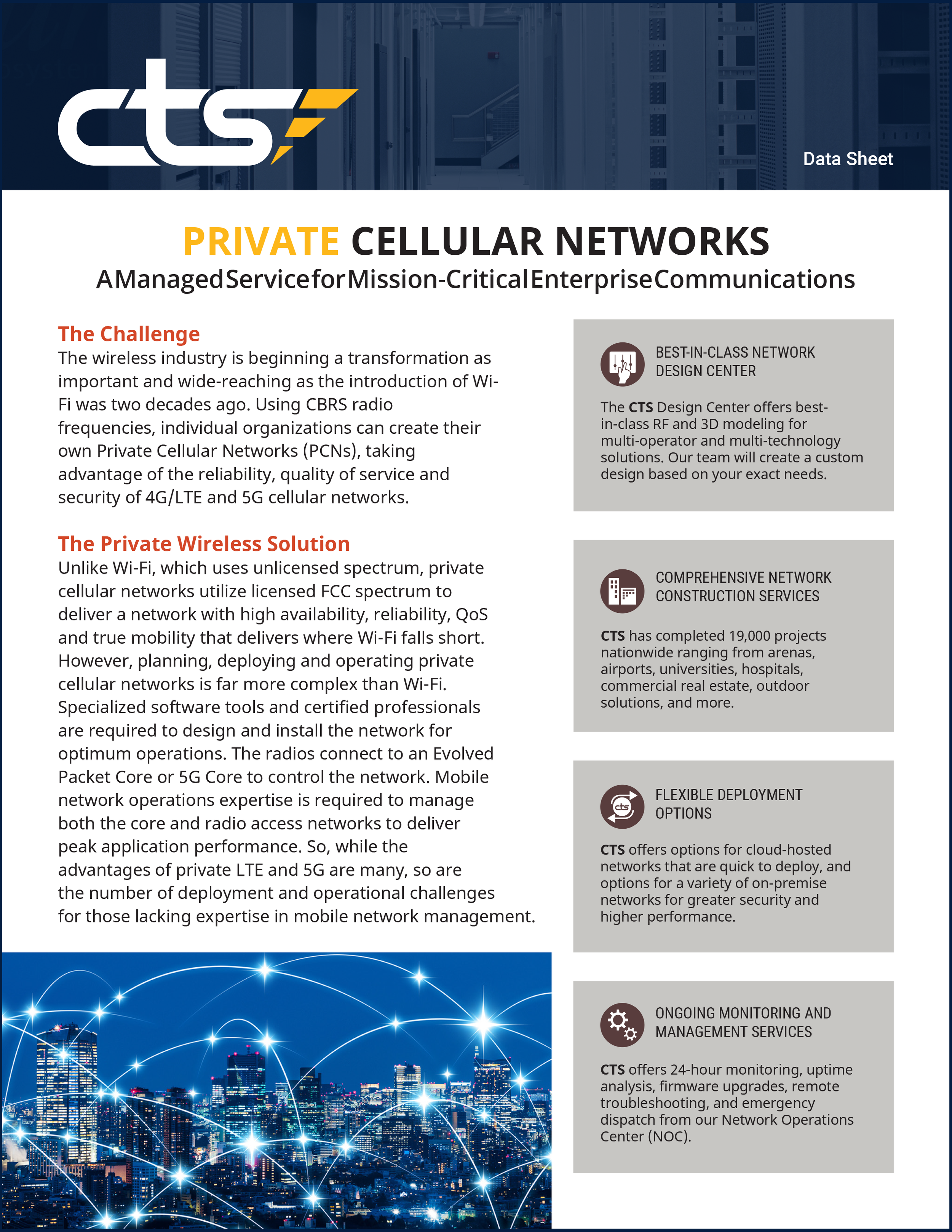
Download the Data Sheet
Learn about the benefits of CTS Private Cellular Networks.
-

Webinar
See how CTS delivered a private 5G Standalone network for a semiconductor fabrication facility.
-

Whitepaper
Learn how CBRS supports enterprise private LTE and private 5G deployments in the United States.
-

Whitepaper
Learn how private cellular supports industrial IoT, automation, mobility, and OT segmentation.
Compare private cellular network options, understand where Private LTE and private 5G fit, and evaluate the business case for enterprise private wireless connectivity.
Private Cellular Insights
Private Cellular vs Public Cellular →
Learn how enterprise-controlled private cellular networks differ from carrier-owned public cellular networks for ownership, coverage, security, performance, and enterprise use cases.
Private Cellular Network vs Private Wireless Network →
Clarify the difference between private cellular networks and broader private wireless network options, including Wi-Fi, CBRS, Private LTE, private 5G, and point-to-point wireless.
Compare Private LTE, private 5G, and Wi-Fi for in-building connectivity, including mobility, device control, security, smart buildings, IoT, and critical operations.
Building the Business Case for Private LTE and 5G →
Evaluate private cellular costs, ROI factors, procurement considerations, operational risk, lifecycle support, and deployment planning.
Frequently Asked Questions About Private Cellular Networks
-
A private cellular network is a dedicated LTE or 5G wireless network deployed for one organization, facility, or campus. Unlike public cellular service, which is operated by mobile carriers and shared across many users and locations, a private cellular network is designed around a specific enterprise environment. It gives the organization more control over coverage, access, security policies, connected devices, and operational performance.
-
Private cellular gives enterprises a dedicated wireless layer for operational use cases that require coverage, mobility, security, and control. Common benefits include broader indoor and outdoor coverage, SIM-based device authentication, support for high-density IoT, improved mobility for moving devices, and better separation between operational technology traffic and general enterprise networks. It is especially useful when Wi-Fi or public cellular cannot reliably support the required workflow.
-
Wi-Fi is well suited for office devices, guest access, localized indoor coverage, and general business connectivity. Private cellular is better suited for wide-area coverage, continuous mobility, outdoor operations, industrial IoT, and OT segmentation. It uses licensed or lightly licensed spectrum, commonly CBRS in the U.S., and SIM-based access control. Private cellular does not replace Wi-Fi across the enterprise. It extends wireless connectivity into use cases where Wi-Fi may reach its limits.
-
CBRS GAA, or General Authorized Access, provides authorized access to available CBRS spectrum through the Spectrum Access System. It is often the practical starting point for enterprise private LTE and private 5G deployments. CBRS PAL, or Priority Access License, provides priority rights within the CBRS band. PAL may be useful when an environment requires stronger spectrum protection, more predictable channel access, or additional interference risk management.
-
Private cellular networks can use different spectrum models depending on the country, carrier requirements, and deployment environment. In the United States, CBRS is the most common path for enterprise private LTE and private 5G because it provides coordinated access to 3.5 GHz spectrum without requiring a carrier-style spectrum purchase. CTS also evaluates CBRS GAA, CBRS PAL, licensed carrier spectrum, and MOCN neutral host options when designing the right architecture.
-
Many enterprise private cellular deployments start with private LTE because the device ecosystem is broad and the architecture is mature. Private 5G is appropriate when the use case, device roadmap, throughput needs, latency requirements, or long-term technology strategy justify it. The right choice depends on the applications, connected devices, deployment timeline, spectrum model, and operational requirements. CTS can design private cellular architectures with a path toward 5G where appropriate.
-
Private cellular is a strong fit for applications that need dedicated wireless coverage, mobility, security, or operational control. Common examples include AGVs, AMRs, industrial IoT sensors, scanners, cameras, connected equipment, push-to-talk devices, mobile workers, safety systems, and outdoor operations. Devices must support the selected LTE or 5G bands and SIM or eSIM-based authentication. CTS evaluates device compatibility during the assessment and design process.
-
Yes, private cellular networks typically use SIMs or eSIMs to authenticate devices. SIM-based access control helps ensure that only authorized devices connect to the network. This model can provide stronger device-level control than password-based wireless access, especially for operational technology, IoT, safety, security, and industrial systems. SIM lifecycle management is also part of the ongoing operational model for many private cellular deployments.
-
Yes. Private cellular can be designed for indoor, outdoor, or mixed-use environments. Common deployment areas include manufacturing plants, warehouses, hospitals, campuses, outdoor yards, parking areas, loading docks, construction sites, and large-span facilities. The final design depends on RF conditions, spectrum selection, radio placement, coverage goals, capacity requirements, device needs, and application performance targets.
-
A private cellular deployment requires RF planning, spectrum evaluation, radio design, core network architecture, SIM provisioning, device onboarding, backhaul, security policies, and integration with IT and OT systems. It also requires ongoing monitoring, updates, troubleshooting, vendor coordination, and lifecycle planning. CTS supports the full lifecycle, from assessment and design through deployment, optimization, and managed operations.
-
A private cellular network can be managed by the enterprise, by CTS, or through a shared operating model. CTS offers managed private cellular services that may include Network Operations Center monitoring, spectrum coordination, SIM lifecycle management, firmware updates, performance reporting, fault resolution, vendor support, and lifecycle planning. For organizations that prefer an operating expense model, CTS can also support private cellular through Network-as-a-Service.
-
Private cellular network cost depends on facility size, indoor and outdoor coverage requirements, radio count, spectrum model, LTE or 5G architecture, connected devices, IT and OT integration, and managed service requirements. ROI should be evaluated against the operational problem being solved, such as automation uptime, outdoor coverage, safety monitoring, IoT performance, staff mobility, or reduced network complexity. CTS can compare private cellular, Wi-Fi upgrades, and managed service models during assessment.
Build the Right Private Cellular Network for Your Environment
CTS designs, deploys, and manages private cellular networks around your facility, devices, applications, and operational requirements. Whether you need private LTE, private 5G, CBRS, managed services, or a Network-as-a-Service model, CTS can help evaluate the right path.